A gold bracelet worn every day takes more direct punishment than almost any other piece of jewelry. Every time you open a door, pull on a knit sweater, or lean across a desk, the chain absorbs friction, torsion, and sudden tension. When a chain fails, the issue is rarely gold purity. It almost always comes down to link geometry and wire thickness.
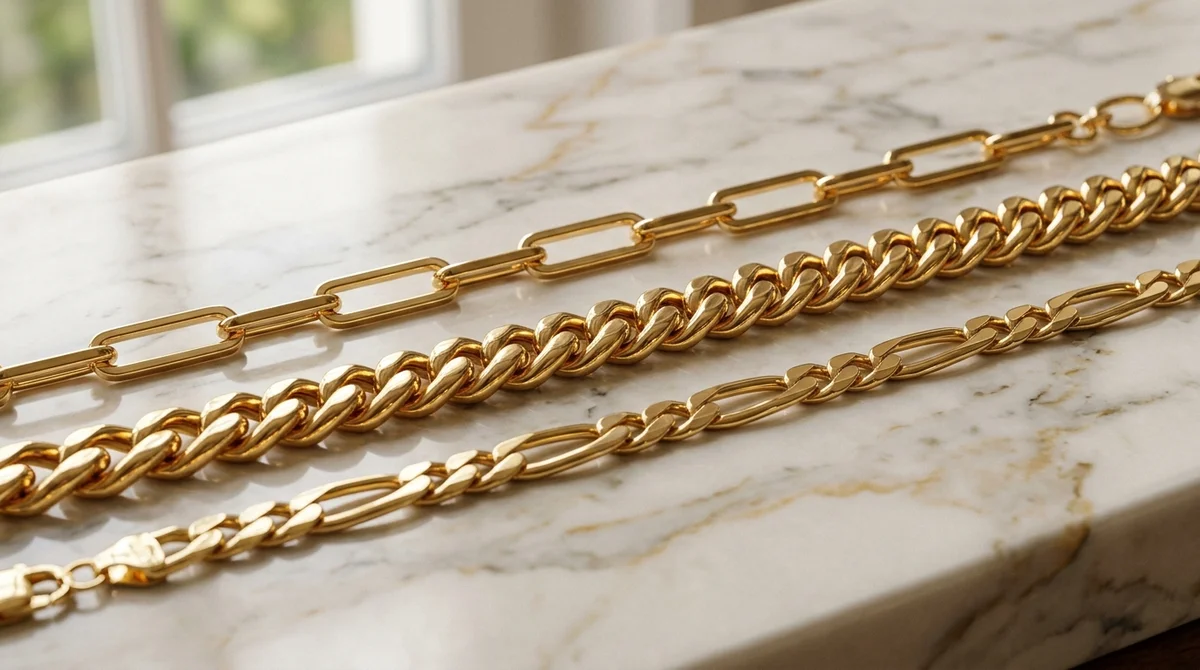
Shoppers looking for an everyday gold bracelet usually gravitate toward three designs: the modern Paperclip chain, the heavy Miami Cuban link, and the Italian Figaro. Each silhouette behaves differently under mechanical stress. Knowing how these links distribute tension will keep you from losing an expensive investment to an accidental snag.
1. Cuban Link Bracelets: Structural Benchmark for Strength
The Cuban link remains the strongest chain design in fine jewelry. Developed from the classic curb chain, a Cuban link uses thick, rounded circular wire links that are twisted and diamond-cut on both faces so the bracelet rests flat against your wrist.
Why Compact Links Resist Torsion
Because each link nests tightly into the next, there are virtually no open gaps for foreign objects to enter. If your wrist catches on a car door or gym bag strap, the sudden pulling force transfers across four or five soldered links at once instead of concentrating on a single junction. The flat profile also keeps the bracelet from rolling or kinking during movement.
Pros
- Highest tensile strength among fine jewelry chains when cast solid.
- Flat diamond-cut profile prevents rolling, hair-pulling, and fabric snags.
- High gold density delivers reliable long-term intrinsic value.
Cons
- Noticeable weight on the wrist in widths above 6mm.
- Higher initial price point due to overall gold mass.
- Hollow versions dent permanently under light pressure.
2. Figaro Bracelets: Traditional European Balance
Developed in Italy, the Figaro chain follows a rhythmic pattern: three short circular links followed by one elongated oval link. This 3-and-1 cadence reduces the total metal weight while maintaining the flat, comfortable look of a curb chain.
Strength and Weight Distribution
Like the Cuban link, Figaro chains are flattened to lie flush against your skin, which minimizes friction against clothing. The short round links provide dependable strength. The long oval link, however, is a minor weak point under heavy force. Under sudden lateral tension, the elongated link absorbs the highest bending force and can stretch out of shape before the round links give way.
Pros
- Time-tested Italian pattern with distinct visual rhythm.
- Flush fit reduces twisting and fabric catching.
- Lower gold weight makes it more accessible than a Cuban link of equal width.
Cons
- The elongated link stretches under severe snagging.
- Aesthetic feels distinctly traditional rather than ultra-modern.
3. Paperclip Bracelets: Aesthetic Focus with Mechanical Limits
Jeweler Warning: Prioritize Gauge Over Trend
Paperclip bracelets are built for visual lightness and stacking, not heavy daily use. Their open rectangular geometry makes them vulnerable to bending under sudden tension.
Paperclip chains use elongated, open rectangular links with gently rounded corners. The design looks clean and pairs well with cuffs or luxury watches, but the open structure introduces clear mechanical vulnerabilities.
Why Rectangular Links Bend
The straight sides of each rectangular link function as lever arms. When the bracelet snags on a car handle or knit blanket, the force applies bending pressure directly across the middle of the wire. This can bow the sides inward or pull the solder seam open. The open gaps also make it easy for sweater fibers, bag straps, and hair to catch inside the link.
Pros
- Clean, contemporary silhouette popular for bracelet stacking.
- Looks substantial without the full weight of a solid curb chain.
- Pairs smoothly with leather watch straps and bangles.
Cons
- Catches frequently on loose-knit clothing and delicate fabrics.
- Long wire segments warp easily under moderate pulling force.
- Unsuited for sleeping, gym workouts, or manual work.
The Solid vs. Hollow Gold Trap
Regardless of whether you choose Cuban, Figaro, or Paperclip, construction quality matters more than link style. Even an 8mm Cuban link will crush and dent if the gold is hollow.
Hollow gold chains are manufactured by wrapping a thin gold sheet around a base metal core, such as copper or iron, and dissolving the core with acid. This leaves a fragile, hollow tube. While hollow chains cost substantially less, repairing them is difficult. A jeweler using a torch will often melt the paper-thin walls, meaning damaged links must usually be cut out rather than re-soldered. Always verify gram weight before buying. If a wide bracelet feels light on your palm, it is hollow.
Frequently Asked Questions
Which bracelet chain is safest to wear while sleeping?
A solid Cuban link chain is the safest choice for sleeping. Its rounded, interlocking links have no sharp protrusions to catch on bedsheets, and its high tensile strength prevents accidental stretching when you turn in bed.
Can paperclip bracelets handle everyday wear?
Paperclip bracelets can withstand daily use only when made from solid gold with substantial wire thickness, ideally 3.5mm to 4mm wide. Hollow paperclip chains should be avoided for daily wear, as their long straight sides warp easily under tension.
Which chain style tangles the least?
Cuban and Figaro chains resist tangling because their diamond-cut links lie flat against your wrist. Their interlocking geometry prevents the bracelet from twisting around itself or pulling body hair.
Can a jeweler repair a broken paperclip link invisibly?
If the bracelet is solid gold, a jeweler using pulse-arc or laser welding can close the seam cleanly. With hollow chains, torch heat melts the thin walls, forcing the jeweler to cut out the broken link and shorten the bracelet.
What is the technical difference between a Miami Cuban and a standard curb chain?
A Miami Cuban link features rounder wire and tighter interlinking with minimal open space between links. Standard curb chains use flatter, wider links with noticeable gaps, offering lower tensile resistance under heavy pulling force.
Can I shower or swim with a solid gold bracelet?
Showering with solid 14k or 18k gold causes no metal damage, though soap residues gradually dull the polish. Swimming pools and hot tubs must be avoided because chlorine causes stress-corrosion cracking in the alloy binders (copper, zinc, and nickel), which can cause solder joints to snap unexpectedly.
Why does a Figaro chain use three short links and one long link?
Named after the lively character in The Marriage of Figaro, the 3-plus-1 link pattern adds visual variety. Mechanically, substituting one elongated link for multiple short links reduces gold consumption by 15% to 25% while maintaining the overall width and presence of the bracelet.
What chain width is best for trouble-free daily wear?
For reliable everyday resilience, aim for 3.5mm to 6mm on Cuban links, 3mm to 5mm on Figaro chains, and at least 4mm on Paperclip styles. Chains under 2.5mm lack the structural mass to survive accidental snags against outerwear or bags.
How do you check if a bracelet is solid or hollow before buying?
Check the piece's scale weight against its dimensions. A 7-inch solid 14k gold Cuban bracelet at 5mm width weighs between 15 and 22 grams. If a piece with those exact measurements weighs only 5 to 7 grams, the core has been acid-etched out and the chain is hollow.
Which clasp is safest for heavy chain bracelets?
A custom box lock clasp with dual figure-eight safety catches offers the highest security for heavy Cuban and Figaro chains. Unlike lobster claws, which rely on an internal steel spring that fatigues over time, a double-latched box lock provides mechanical redundancy against accidental release.
The Bottom Line: If you are spending serious money on a 14k or 18k gold bracelet, longevity must be your priority. The Cuban link is an absolute tank, the Figaro is a perfect classic compromise, and the Paperclip is a fragile trend strictly for aesthetics.
Choose a solid Cuban for 24/7 active lifestyles, sleeping, and gym wear. Choose a Figaro if you want exceptional strength but prefer a more intricate, traditional European design.
The structural engineering of rounded, interwoven, flat-laying links guarantees tension is distributed across multiple points rather than single vulnerable junctions.
Never buy a hollow Paperclip chain. The elongated straight sides of the hollow links will stretch, buckle, and snap under the slightest pressure, and jewelers will not be able to repair it seamlessly.
Sources & Methodology
Researched and reviewed by Bishnu Tudu (Independent Jewelry & Gemstone Researcher) in accordance with our Editorial Policy. Technical specifications, mineral durability metrics, alloy standards, and regulatory requirements were cross-referenced against the following primary sources:
- Gemological Institute of America (GIA): Diamond & Gemstone Education & Grading Standards. View GIA Standards
- Federal Trade Commission (FTC): Guides for the Jewelry, Precious Metals, and Pewter Industries. View FTC Guides
- Responsible Jewellery Council (RJC): Code of Practices for Sustainable & Ethical Jewelry Supply Chains. View RJC Standards
- Oshinic Jewels: Independent Jewelry Research, Sourcing & Editorial Methodology. View Editorial Policy