Between surgical scrubs, snapping on tight nitrile gloves 40 times a shift, and moving patients during a code, wearing fine jewelry on a hospital floor is risky. Bench jewelers see the aftermath constantly: ripped gloves mid-procedure, lost center stones in trauma bays, and settings packed with hardened soap and skin cells that fail infection control audits.
Hospital jewelry does not need to be fragile. Safe clinical jewelry design comes down to low vertical profiles, snag-free perimeters, and solid metal alloys that withstand impact, mechanical friction, and heavy sanitizing.
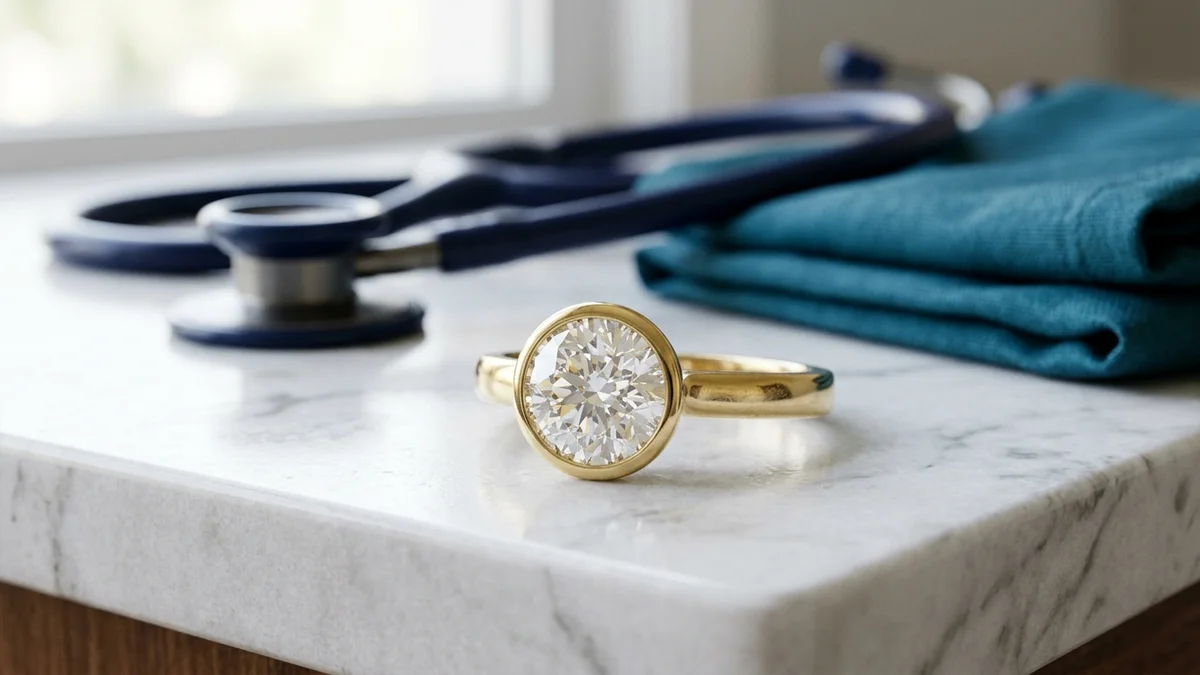
- Best Overall Setting: Full Bezel or Flush Mount (completely snag-free with zero protruding prongs).
- Maximum Profile Height: Keep basket height at or below 5.0mm off the finger to prevent glove friction.
- Glove-Safe Diamond Shapes: Round Brilliant, Oval, or Cushion cuts (no sharp points to puncture nitrile).
- Most Resilient Metals: Platinum (PT950) and 14K Solid Gold (resists dents from steel bed rails and tolerates daily alcohol hand rubs).
- On-Shift Alternatives: Ring keeper necklaces or medical silicone bands for strict "bare below the elbows" units.
The 3 Biggest Threats to Fine Jewelry in Hospital Settings
Hospital floors expose rings to mechanical force and harsh chemicals that standard commercial jewelry isn't built to handle.
1. Glove Punctures & PPE Tears
Standard 3–5 mil examination nitrile gloves tear easily when stretched over raised prongs, breaking the sterile barrier and exposing skin to biohazards.
2. Bacterial Biofilm Accumulation
Open prongs and hollow galleries trap soap scum, dried hand sanitizer, and skin flora, creating micro-pockets where pathogens like MRSA and Gram-negative bacilli thrive.
3. Impact & Mechanical Friction
Strikes against steel bed rails bend thin shanks, while constant hand rubbing and glove friction rapidly abrade rhodium plating down to the raw alloy.
The 4 Best Engagement Ring Settings for Nurses
When evaluating low profile engagement rings for nurses, prioritize flat architecture and seamless metal protection. Here are the 4 most dependable settings:
1. Full Bezel & Half Bezel (The Gold Standard)
A bezel setting replaces individual prongs with a continuous rim of precious metal wrapped completely around the diamond's girdle.
- Pros: Zero snag points. Completely shields diamond edges from chipping against metal equipment and presents no sharp prongs to tear gloves.
- Cons: Covers the outer edge of the stone, slightly reducing side-light entry compared to an elevated open basket.
2. Flush / Gypsy Mount Setting
In a flush mount, the jeweler sinks the diamond directly into a drilled cavity in the band and burnishes metal over the girdle, so the diamond sits level with the ring's outer surface.
- Pros: Zero vertical rise. Gloved fingers glide smoothly across the metal with nothing to catch on sheets or PPE.
- Cons: Requires a band at least 3.0mm wide and works best with center stones under 0.75 carats.
3. Low-Basket 4-Prong Solitaire (≤ 4.5mm Height)
If you prefer prongs for maximum sparkle, the basket holding the diamond must be soldered flush to the band, keeping total height under 4.5mm.
- Pros: Excellent light entry and diamond brilliance while keeping the center of gravity close to the finger.
- Cons: Can catch on tight gloves during rapid changes. Prongs need a yearly jeweler check for movement.
4. Channel-Set & Micro-Bezel Accent Bands
If you want side stones or an eternity band, avoid surface prongs (pavé). Instead, choose channel settings, where diamonds sit protected between two parallel metal walls.
- Pros: Holds accent stones securely inside smooth metal rails, eliminating lost gems and snag points.
- Cons: Full-eternity channel rings cannot be easily resized later.
Clinical Performance Comparison: Setting Types
| Setting Type | Glove Tear Risk | Biofilm Retention | Profile Height | Ideal Diamond Cuts | Clinical Score |
|---|---|---|---|---|---|
| Full Bezel | Zero (0%) | Extremely Low | 3.5 – 4.8 mm | Round, Oval, Cushion | 10 / 10 |
| Flush / Gypsy | Zero (0%) | None (Seamless) | 2.0 – 3.0 mm | Round Brilliant | 9.5 / 10 |
| Low-Basket 4-Prong | Low (Rounded prongs) | Low to Moderate | 4.0 – 5.0 mm | Round, Cushion | 8.5 / 10 |
| Channel-Set Band | Zero (0%) | Low | 2.5 – 3.5 mm | Baguette, Round | 9.0 / 10 |
| High Cathedral Peg-Head | Severe (High Snag) | High (Biofilm trap) | 7.0 – 9.0 mm | All cuts | 2.0 / 10 |
Settings & Styles to Strictly Avoid on Duty
If you work in direct patient care, eliminate these four high-risk designs from your shortlist:
High Cathedral & Peg-Heads
Lifting a stone 7mm–9mm off the finger creates leverage. Bumping bed rails or IV poles bends prongs back and dislodges center stones.
Tension Mountings
Tension settings rely entirely on spring pressure from the band. Glove pressure and temperature swings can loosen the grip, dropping the stone.
Micro-Pavé Bands
Pavé bands use tiny 0.5mm prongs to hold side diamonds. Pulling off tight gloves catches these small metal beads and pulls them open.
Vintage Filigree & Milgrain
Intricate scrollwork and hollow pockets under the stone trap soap scum and body fluids, making real sanitization impossible.
Diamond Cuts & Gemstone Hardness: What Survives Clinical Work?
Shape and crystal hardness determine whether your stone survives shift-work friction.
Best vs. Worst Diamond Shapes
Choose shapes with rounded, continuous perimeters. Round Brilliant, Oval, and Cushion cuts distribute pressure evenly with no exposed sharp corners.
In contrast, Princess, Marquise, and Pear cuts feature acute points. Striking a metal tray will chip an unprotected tip. If you want a pear or marquise stone, protect it with a full bezel or sturdy V-shaped corner prongs. When shopping, check how to read a diamond grading report to confirm the girdle is rated "Medium to Slightly Thick" rather than fragile "Extremely Thin".
Alternative Gemstones: The Mohs Hardness Reality
If you're considering non-diamond center stones, chemical resistance and mineral hardness matter most:
Hospital-Approved Stones
Chemical & Scratch Resistant- Mohs 10Natural & Lab Diamonds: Impervious to hospital sanitizers, abrasives, and accidental scratches.
- Mohs 9.25Moissanite: Silicon carbide crystal with exceptional thermal and chemical stability, plus strong optical fire.
- Mohs 9Sapphires & Rubies: Dense corundum structure with no cleavage planes, standing up reliably to daily cleaning agents.
Stones to Avoid on Duty
High Risk of Clouding & Fracture- Mohs 7.5-8Emeralds: Naturally included; hospital alcohol strips clarity-enhancing cedarwood oils and resins, leaving dry, cloudy fractures that crack under minor impact.
- Mohs 2.5-6.5Opals & Pearls: Opals (porous hydrated silica) dehydrate and craze in alcohol; organic pearls suffer nacre pitting from acidic and alcoholic sanitizers.
- Mohs 7.5Morganite: Naturally oleophilic surface quickly attracts glycerin from sanitizers and lotion films, developing a cloudy haze without weekly degreasing.
The Metal Debate: Platinum vs. 14K Gold vs. 18K Gold
Metal hardness, chemical stability, and alloy purity dictate how long your band lasts. For details on gold alloys, read our 14K solid gold vs 18K gold comparison.
- Platinum: Naturally hypoallergenic, dense (approx. 21.45 g/cm³), and unplated (PT900/PT950). When scratched, the metal displaces into a protective patina rather than wearing away. It is completely inert to hospital alcohol hand rubs.
- 14K Solid Gold (Yellow or Rose): 58.3% pure gold alloyed with copper, silver, and zinc (approx. 130–160 Vickers hardness). This metallurgical structure is significantly more dent- and bend-resistant than softer 18K gold when colliding with steel equipment.
- 14K White Gold: A durable alloy, but the relentless mechanical friction of rubbing hands during sanitizing and pulling tight nitrile gloves abrades the micro-thin (0.5–1.0µm) rhodium plating within 6 to 12 months. This reveals the natural warm, pale-yellow undertone and can trigger nickel sensitivities if the base alloy contains nickel.
- Sterling Silver: Marked 925 (92.5% silver). Too soft for hospital shifts, silver bends under heavy loads, scratches easily, and tarnishes black when exposed to sulfur compounds and hospital skin preps.
Carat Weight & "Ring Spin" Physics on 12-Hour Shifts
When a diamond is large (1.50+ carats) or set on a narrow 1.5mm band, it becomes top-heavy. Glove friction and natural hand movement cause the stone to spin into your palm.
Once flipped into your palm, grabbing a bed rail or blood pressure cuff pushes the diamond straight into your skin, tearing gloves and bruising fingers. To stop ring spin:
- Choose a band between 2.0mm and 2.5mm wide for balanced grip on your finger.
- Pick a Euro-shank (a square-bottomed band) that physically resists rotating.
- Check your accurate size with our interactive ring size calculator, factoring in end-of-shift finger swelling.
If your ring is currently loose or spins in cold weather, try wrapping an invisible spiral ring size adjuster (8-pack) around the base of the band. The soft TPU coils add friction and stop the ring from rotating without altering the metal.
On-Shift Workarounds: Silicone Bands & Ring Keeper Necklaces
Surgical suites, burn units, and neonatal ICUs often enforce strict "bare below the elbows" hygiene rules. These workarounds keep your ring protected while on duty:
1. Medical-Grade Silicone Bands
Keep a silicone band in your scrub pocket. They are non-conductive and engineered to break under 15 to 40 lbs of tensile pressure to prevent traumatic ring avulsion (degloving injuries), keeping your fingers safe while your fine ring stays home.
Good choices include the Enso Elements Silicone Ring (infused with precious metal for a metallic finish) or ROQ Breathable Silicone Bands , which have inner air channels to prevent sweat buildup under tight gloves.
2. Magic Ring Holder Necklaces
Opening a small necklace clasp with slippery, sanitized hands over a hospital sink is risky. A ring holder pendant lets you slide your engagement ring onto a secure wishbone pendant in two seconds without undoing the clasp.
Many nurses wear a Sterling Silver Wishbone Ring Holder Necklace under scrubs for white gold or platinum rings, or a 14K Gold Plated Horseshoe Ring Keeper for yellow and rose gold.
The 3-Step Nurse Shift Protocol for Jewelry Care
Follow this simple 3-step routine on your shifts to protect your ring and maintain clinical hand hygiene:
Pre-Shift Tap Test
Tap the stone near your ear with a fingernail before clocking in. A faint rattle means a loose prong. Leave the ring home until it's tightened.
Donning Technique
Bunch the glove cuff at your fingertips and roll it smoothly forward over the setting. Never drag tight palm latex sideways across the diamond.
Decontamination Soak
Soak the ring weekly for 15 minutes in warm water mixed with lotion-free Dawn dish soap. Brush behind the stone with an ultra-soft baby toothbrush.
For fast touch-ups, a cleaning pen like the Diamond Dazzle Stik cleans behind bezel baskets quickly. For weekly soaks to dissolve dried sanitizer and chlorhexidine film, Connoisseurs Fine Jewelry Cleaner removes residue without harming solid metals.
Frequently Asked Questions: Nurse & Healthcare Ring Dilemmas
1. How do I stop my ring from slipping off into the trash when removing gloves?
Sweat inside nitrile gloves creates suction that pulls rings forward during glove removal. To prevent this, anchor the base of your ring finger with your thumb while peeling the glove off from the wrist cuff inside-out.
2. Why do I get an itchy red rash under my ring after a 12-hour shift?
"Ring rash" is primarily irritant contact dermatitis caused by the "occlusion effect": residual soap surfactants, chlorhexidine, and hand sanitizer get trapped under the band inside impermeable gloves, macerating the skin barrier. A secondary cause is nickel allergy from worn white gold. Prevent it by choosing comfort-fit bands under 2.5mm, letting hands dry completely before putting on gloves, or choosing hypoallergenic platinum.
3. Does spinning my ring so the diamond faces inward protect gloves?
No. Turning the stone inward stops knuckle snags, but grabbing bed rails, IV poles, or doing chest compressions drives the diamond directly into your palm. That impact bends prongs and causes painful bruises.
4. Are nurses allowed to wear engagement rings in the OR, ICU, and NICU?
While CDC hand hygiene guidelines note that skin under rings harbors higher bacterial loads without establishing a universal ban for general floors, surgical standards from AORN require removing all hand and wrist jewelry before surgical scrubs. High-acuity units (OR, NICU, burn units) and facilities enforcing "bare below the elbows" rules prohibit stone-set rings to preserve sterile barriers.
5. Can high-prong rings scratch patients?
Yes. High prongs and pointed diamond shapes (Princess, Marquise, Pear) create skin tear hazards when lifting, boosting, or transferring fragile or elderly patients. Low bezels and flush mounts eliminate sharp contact points.
6. Will hospital alcohol sanitizer damage diamonds or solid gold?
Alcohol sanitizers (isopropanol and ethanol) do not chemically dissolve natural diamonds, platinum, or solid gold. However, the abrasive friction of repeatedly rubbing hands and donning powder-free nitrile gloves accelerates the mechanical wear of rhodium plating on 14K white gold. Additionally, chlorine bleach wipes will chemically corrode gold alloys, and alcohol or solvents will dissolve polymer resins in fracture-filled clarity-enhanced diamonds.
7. Are silicone rings more hygienic than metal rings?
Silicone prevents glove snags and degloving injuries, but it isn't automatically cleaner. Silicone grips skin and traps moisture and skin flora. If you wear silicone on shift, pick a band with inner airflow grooves and wash your ring and finger after every shift.
8. What is a "Magic Ring Keeper" necklace and why do nurses use it?
A Magic Ring Keeper is a wishbone or horseshoe-shaped pendant that lets you loop your engagement ring onto a chain without opening the clasp. It avoids fumbling with tiny clasps over hospital sinks with wet or sanitized hands.
9. Does homeowners insurance cover rings lost in hospital linen or laundry?
Standard home or renters policies cover fire and theft, but often exclude accidental loss. Healthcare workers should get dedicated jewelry insurance (like Jewelers Mutual) covering "mysterious disappearance" if a ring slips into laundry or waste bins.
10. My fingers swell during 12-hour shifts: how should I size my ring?
Standing all day causes fingers to swell up to a half size by shift's end. Measure finger size at the end of the day with our ring size calculator. If the ring is loose in the morning, a jeweler can add sizing beads or a Euro-shank to keep it stable without pinching when swollen.
11. Can a jeweler modify an existing high-prong ring to make it nurse-friendly?
Yes. A bench jeweler can cut down tall prongs and drop the diamond into a flush, low-profile basket under 5.0mm. They can also reset the stone into a custom bezel cup on your existing band.
12. How should healthcare workers decontaminate rings at home?
Never use bleach, autoclaves, or boiling water, as they damage solder joints, corrode alloys, and fracture included stones. Soak the ring weekly in warm water and lotion-free Dawn dish soap for 15 minutes, brush behind the stone with a soft baby toothbrush, rinse under running water, and dry with a microfiber cloth.
For clinical work, the most dependable build is a Round or Cushion diamond in a solid Platinum or 14K Gold full bezel setting under 5.0mm in profile height. It provides full glove compatibility, simple cleaning, and reliable durability through decades of hospital shifts.
Authoritative Clinical & Gemological Sources
This article was researched and written in accordance with the Oshinic Jewels Editorial Policy. Claims regarding gemstone quality, metal durability, pricing, sizing, and skin health were independently verified against the following authoritative industry standards:
- Gemological Institute of America (GIA): Diamond & Gemstone Education & Grading Standards. View GIA Standards
- Federal Trade Commission (FTC): Guides for the Jewelry, Precious Metals, and Pewter Industries. View FTC Guides
- Responsible Jewellery Council (RJC): Code of Practices for Sustainable & Ethical Jewelry Supply Chains. View RJC Standards
- Oshinic Jewels: Independent Jewelry Research, Sourcing & Editorial Methodology. View Editorial Policy
- CDC Guideline for Hand Hygiene in Healthcare Settings: Clinical data on subungual and sub-ring bacterial colonization, pathogen retention under jewelry, and hand rubbing efficacy. View Guidelines
- AORN Guidelines for Surgical Attire & Scrubbing: Standards regarding complete hand and wrist jewelry removal prior to surgical scrubbing and sterile field operations. View Standards
- World Gold Council (WGC) & Manufacturing Jewelers (MJSA): Metallurgical specifications for karat gold alloys and Vickers hardness. View Standards