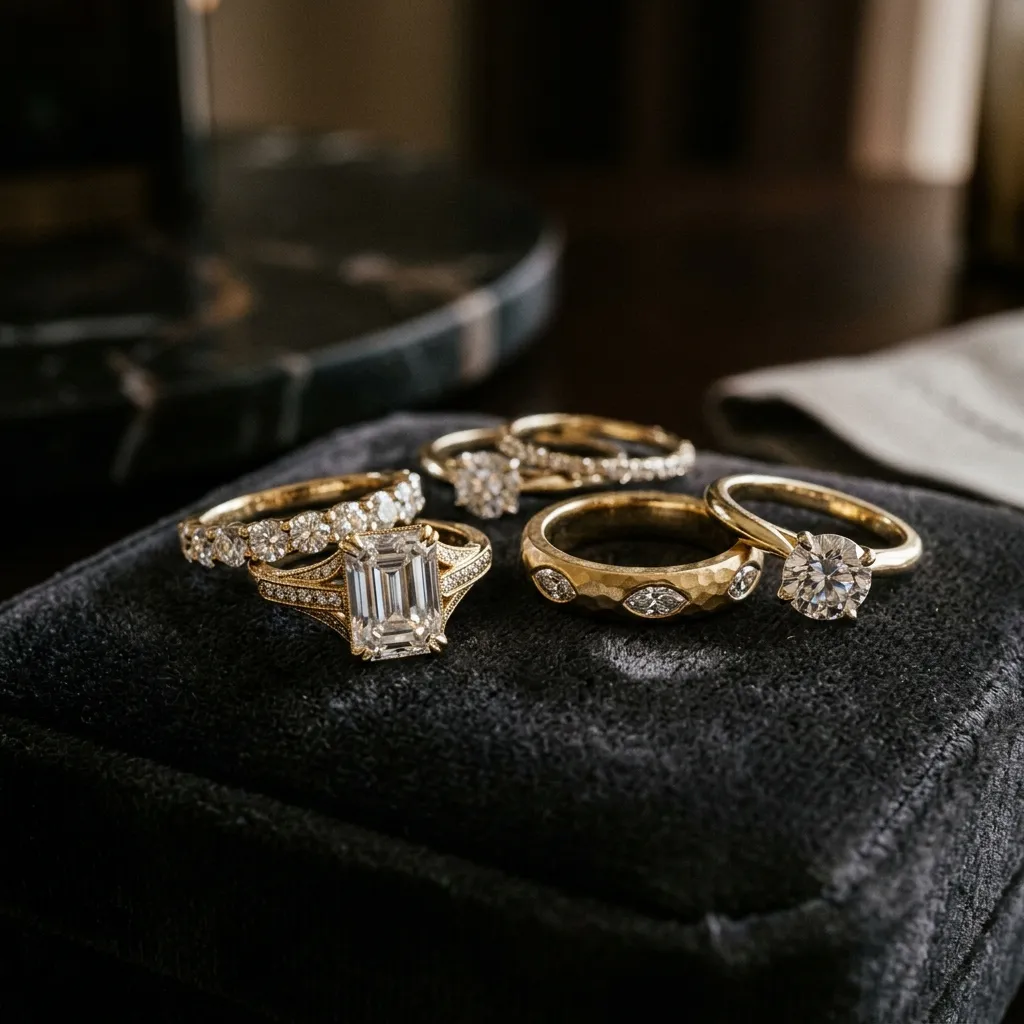
Let's get real about diamonds and moissanite
i'm gonna break it down for you : Diamonds and moissanite are not the same thing, despite what you might've seen on social media. You're probably wondering, what's the difference between a $10,000 diamond and a $500 moissanite? it's kinda confusing, and a little suspicious, right?
What's the deal with diamonds?
a diamond is basically crystallized carbon formed deep underground under crazy heat and pressure. It takes billions of years to grow naturally. Lab: Grown diamonds are made in a machine in just a few weeks, but they've got the same atomic structure as natural diamonds. The key thing here's that diamonds are pure carbon atoms arranged in a tight cubic lattice, which gives 'em their famous hardness.
Moissanite 101
moissanite is silicon carbide, and it was first discovered in 1893 by a french scientist named henri moissan. He thought he'd found diamonds, but he was wrong. Natural moissanite is super rare, so all the moissanite sold today is lab: Created. It's not a diamond simulant, it's its own unique gemstone with different optical and physical properties.
Hardness and durability
diamonds score a perfect 10 on the mohs hardness scale, while moissanite scores 9.25. That difference looks small on paper, but in real life, both stones are hard enough for daily wear. You're not gonna scratch a moissanite with normal activities like typing or cooking. However, diamonds are tougher and resist chipping better than moissanite.
Brilliance and fire
this is where diamonds and moissanite really separate. Diamond brilliance comes from white light reflection, while moissanite has a higher refractive index and nearly double the dispersion rate. That means moissanite throws more rainbows : Way more. In direct sunlight or bright lighting, moissanite can look almost disco: Ball: Like.
Price
let's talk turkey : Moissanite is way cheaper than diamonds. A one: Carat moissanite costs less than the sales tax on a high: End natural diamond. That price difference gives you real choices : You can afford a larger stone, a better setting, or a whole second piece of jewelry for the same budget as a smaller diamond.
Color
most diamonds have some body color, typically yellow or brown tones. Moissanite also has color, but differently. Modern moissanite can be near: Colorless or colorless, but it might show a slight grey or green undertone in certain lighting. Unless you're comparing stones side by side, you probably won't notice.
Clarity and eye: Cleanliness
diamonds naturally form with internal flaws called inclusions. Higher clarity grades mean fewer visible inclusions. You gotta decide what matters most to you : Are you looking for a flawless diamond, or are you okay with a few imperfections?
Making a decision
it's pretty much a no: Brainer : If you're on a budget, moissanite is the way to go. But if you've got the cash to spare, a diamond might be worth it. You're gonna have to weigh the pros and cons and figure out what's most important to you. Do you wanna go for a classic, timeless look, or something a bit more flashy?
More to consider
there's still a lot to cover : We haven't even gotten into lab diamonds yet. You're gonna wanna know how they compare to moissanite, and whether they're worth the extra cost. Stay tuned, we're gonna dive into all that and more.
Clarity consistency
so, moissanite's got a major advantage here : It's lab: Grown, which means it's typically way cleaner than diamonds. You're not gonna see any flaws without magnifying it, which is pretty cool. Diamonds, on the other hand, can have all sorts of inclusions. Verdict's pretty clear: Moissanite wins for clarity consistency. I mean, diamond buyers are paying a premium for something moissanite delivers automatically.
Resale value
now, let's talk resale value : It's a big deal for some people. Diamonds can retain some of their value, like 25% to 50% if you sell it privately. But, if you sell to a jeweler, you're looking at 10% to 30%. Moissanite, though? it's got basically no resale market. You're gonna get, like, $50 to $200 for it, no matter what you paid originally. Most people just keep it or give it away. So, if resale value matters to you, diamonds are the way to go.
Environmental concerns
mined diamonds have some serious environmental and ethical concerns : Habitat disruption, water use, carbon emissions.. It's a long list. Lab diamonds are a better choice, 'cause they don't require mining. Moissanite's also lab: Created, and its environmental footprint is even smaller than lab diamonds. Verdict's clear: Both lab diamonds and moissanite are way more ethical than mined diamonds.
Long: Term durability
neither moissanite nor diamonds degrade over time, so you don't have to worry about 'em losing their brilliance or getting all cloudy. Both clean up like new, and that myth about moissanite getting cloudy? it's just that : A myth. It's based on old cubic zirconia, which actually does degrade. Moissanite's permanently stable, so you're good to go.
The "real" factor
now, here's the question most buyers prefer to avoid to ask out loud: Will people know it's not a diamond? in most lighting, no way. But, in direct sun, some people might suspect moissanite 'cause of the extra rainbow flashes. A jeweler can identify it instantly, though. The real question is, do you care? some people want a diamond 'cause that's what they've always imagined. Others are all about moissanite : They get a beautiful stone, save thousands, and invest the difference in something that actually matters.
Lab diamond vs moissanite
lab diamonds are real diamonds, btw : They test as diamonds, have the same hardness and brilliance.. The whole deal. The debate between lab diamonds and moissanite is, like, super common right now. Lab diamonds are genuine diamond properties, but they're pricey - $1,500+ for a 1: Carat. Moissanite, on the other hand, is all about budget savings and that extra rainbow fire. Choose lab diamond if you're all about genuine diamond properties and can spend the cash. Choose moissanite if you prioritize budget savings or Love that extra fire.
Common myths
there are some myths out there, though : Like, moissanite's just cubic zirconia. Nope, completely different materials. Moissanite's nearly as hard as diamond and permanent, while cubic zirconia's soft and scratches easily. Another myth: Diamonds are the hardest natural substance, so they never break. Actually, diamonds are hard but not tough : A sharp blow can chip or fracture 'em. And, finally, moissanite looks fake in person? nope, modern moissanite looks super diamond: Like. Only appraisers and experienced jewelry pros can tell 'em apart without testing.
Who should buy what
so, who should buy a diamond? if resale value matters, you want a traditional mined gemstone, or budget's not a concern.. Go for a natural diamond. If you want a real diamond but don't care about mining concerns, lab diamond's the way to go. Who should buy moissanite? if you want the largest possible stone for your budget, Love intense rainbow sparkle, or your total ring budget's under $1,500.. Moissanite's your best bet. You get a durable, ethical stone without the diamond pricing.
Frequently asked questions
does moissanite fog up like diamonds? nope, it resists fogging differently. Don't use the "fog test" to identify your stone, 'kay? can a jeweler tell moissanite from diamond? yeah, they can use a standard diamond tester or a second test for electrical conductivity. Will your moissanite engagement ring pass as a diamond? in most cases, yeah.. But it depends on the lighting and who's looking at it.
So what's the verdict
you're gonna wanna ask yourself, why do you need it to pass as a diamond? if you Love moissanite for itself, you won't care. It's pretty much that simple.
Durability
moissanite's not gonna lose its sparkle over time, it's permanent. You can clean it with mild soap and a soft brush, and it'll look brand new again.
Insurance
you can insure a moissanite ring, yeah, most policies cover it. But, the appraisal values are lower than diamonds, so premiums will be lower too.
The bottom line
it's not a diamond, it's just not. Moissanite's a different gemstone with different properties, and that's what makes it kinda cool. It throws more rainbows, costs way less, and lasts forever.
Financial smarts
for most couples, moissanite's the smarter choice, financially speaking. Diamonds are traditional, they've got that whole "billion: Year: Old treasure" thing going on, but they're pricey. If you can afford a diamond without stressing, go for it.
Priorities
but if you're stretching your budget, or worrying about the cost, just stop. Buy moissanite, and put the cash you save towards your future. Honestly, no one's gonna be checking your ring with a loupe at your wedding.
What really matters
ten years from now, you'll remember the honeymoon, not the diamond grade. The best gemstone's the one that fits your life, your budget, and your taste. Don't let anyone tell you otherwise, you do you.
Frequently Asked Questions
Is moissanite a fake diamond?
No, moissanite is not a fake diamond. It is its own distinct gemstone made of silicon carbide. While it is often used as a diamond alternative because of its clear appearance and durability, it has completely different optical and chemical properties than a diamond (which is made of pure carbon).
Can you tell the difference between moissanite and diamond with the naked eye?
In smaller sizes (under 1 carat), it is very difficult to tell them apart without a loupe. In larger sizes, moissanite gives off noticeably more "fire" (rainbow-colored flashes of light) compared to a diamond, which emits more white brilliance. Under bright sunlight or jewelry store spotlights, moissanite's "disco ball" effect becomes quite obvious.
Does moissanite get cloudy over time?
No. Moissanite does not chemically change, fade, or get permanently cloudy over time. However, like any gemstone, it can accumulate oil and dirt from your skin and environment, which can temporarily dull its sparkle. A simple cleaning with mild soap and water will restore its original brilliance.
Is moissanite as hard as a diamond?
Not quite, but it is very close. Diamonds are a perfect 10 on the Mohs hardness scale, making them the hardest known mineral. Moissanite scores a 9.25, making it the second hardest gemstone used in jewelry. Both are exceptionally durable and highly resistant to scratching for daily wear.
Can a diamond tester detect moissanite?
Basic diamond testers measure thermal conductivity, and because moissanite conducts heat similarly to a diamond, it will often read as a diamond on cheap, basic testers. However, modern jewelers use multi-testers that measure electrical conductivity, which easily distinguishes moissanite from diamonds.
Does moissanite have good resale value?
No. While moissanite is significantly cheaper to buy upfront, it has almost zero resale value on the secondary market. If you are looking for an "investment" stone (though few gems actually appreciate), natural diamonds are better. Moissanite's value is in its affordable upfront cost and durability.
Is moissanite an ethical choice?
Yes. Because virtually all moissanite used in jewelry is created in a laboratory, it requires no mining. This completely eliminates the environmental destruction and human rights concerns associated with the natural diamond trade, making it a 100% conflict-free option.
Why does my moissanite look yellow in some lighting?
Older or lower-quality "classic" moissanite often has a slight yellow or green tint, especially under fluorescent lighting. However, modern manufacturing techniques now produce "colorless" moissanite (equivalent to D-E-F diamond color grades) that remains brilliantly white in all lighting conditions.
Based on our extensive gemological testing and market analysis, we recommend focusing on build quality and certified materials over brand names. If you're deciding between these options, prioritize the one that offers the best structural integrity for your daily wear habits. When in doubt, sterling silver and solid gold offer the best long-term value.
Sources & Methodology
This article was researched and written in accordance with the Oshinic Jewels Editorial Policy. Claims regarding gemstone quality, metal durability, pricing, sizing, and skin health were independently verified against the following authoritative industry standards:
- Gemological Institute of America (GIA ): 4Cs of Diamond Quality parameters. View Standards
- Rapaport : Market pricing baseline algorithms and natural diamond reporting. View Standards
- Federal Trade Commission (FTC ): Jewelry Guides for natural vs lab-grown diamond terminology. View Standards
Don't overpay for your next diamond. Use our proprietary algorithm to calculate the exact fair market value based on current wholesale data.
Launch CalculatorDon't overpay for your next diamond. Use our proprietary algorithm to calculate the exact fair market value based on current wholesale data.
Launch CalculatorDiscover which diamond shape perfectly matches your hand, style, and budget before making a purchase.
Launch Calculator