Introduction
There is something undeniably architectural, striking, and profoundly sophisticated about baguette diamonds. Unlike the brilliant, blinding sparkle of round cuts or the romantic curves of ovals, baguettes offer clean, geometric "hall of mirrors" reflections that instantly enhance any ring stack to a masterclass in modern design.
Before purchasing a delicate baguette diamond half eternity band, a bold emerald baguette open ring, or a custom three-stone engagement ring, you need to understand the intricate nuances of this unique cut. Buying a step-cut diamond requires a surgical strategy compared to buying a brilliant cut. You cannot simply apply standard diamond buying rules to a baguette and expect a flawless result.
Key Takeaways
- Clarity Priority: Step-cut baguette diamonds have only 14 facets and hide nothing. Always choose VS2 clarity or higher.
- Color Matching: Ensure accent baguettes match or exceed the color grade of your center stone to prevent visual disruption.
- Corner Protection: Sharp 90-degree baguette corners chip easily. Always opt for channel, bezel, or bar settings for daily wear.
- Eternity Sizing Warning: Full baguette eternity bands cannot be resized. Measure your exact size before ordering.
I vividly remember the first time I held a truly high-quality, bespoke baguette eternity band. It was a massive, weighty platinum piece sourced for a private client in New York who was looking for something distinct from ubiquitous pavé bands. The structural elegance was mesmerizing as I set it on the glass viewing counter.
What struck me most intensely was how entirely different it felt to assess its quality through a jeweler's loupe. Because of their broad step-cut facets, baguettes hide absolutely nothing. A poor clarity grade, a slight color mismatch, or an uneven setting stands out immediately, staring back at you like a blatant smudge on a clean, sunlit window.
That high-stakes sourcing trip completely reshaped how I evaluate step-cut stones forever. It cemented the reality that with baguettes, precision, clarity, and flawless execution are quite literally everything.
What Exactly is a Baguette Cut Diamond? The Architectural Masterpiece
Baguette diamonds are categorically known as "step-cut" stones, characterized by their elongated, rectangular shape and straight or distinctly tapered edges. They typically feature only 14 facets, creating a stark contrast to the 57 or 58 tiny facets of a standard round brilliant diamond.
This significantly lower facet count means they are purposefully designed to prioritize clarity, deep luster, and subtle, sophisticated flashes of light rather than intense, fiery brilliance. They are the quiet luxury of the diamond world.
Straight vs. Tapered Baguettes: A Design Distinction
Baguettes generally come in two primary variations, each serving a distinct aesthetic and structural purpose in fine jewelry design:
- Straight Baguettes: These stones are perfectly rectangular with strictly parallel edges and 90-degree corners. They are most commonly used in continuous sequences, such as full eternity bands, half-eternity wedding rings, or stacked tightly together in a channel setting to create a uninterrupted ribbon of light.
- Tapered Baguettes: These specialized stones are wider at one end and narrower at the other, creating a subtle wedge shape. They are famously used as side stones flanking a larger central diamond in a classic three-stone engagement ring, drawing the eye directly inward to the center stone.
The Fascinating History of the Baguette Cut
The term "baguette" originates from the French word for "little stick" or "wand," an apt description of its elongated form. While step cuts have existed for centuries, the baguette cut gained explosive popularity during the glamorous Art Deco and Art Nouveau periods of the 1920s and 1930s.
During this transformative era, avant-garde designers shifted away from the overly ornate curves of the Edwardian era in favor of sharp, geometric, and modern lines. The baguette cut, with its clean symmetry and structural appeal, perfectly embodied the rebellious spirit of modern architecture. It remains a hallmark of Art Deco design to this day.
Decoding the 4Cs for Baguette Diamonds: A New Paradigm
When buying any diamond, the universal 4Cs apply, but their order of importance shifts dramatically when dealing with baguettes.
Clarity: The Absolute Most Critical Factor
Because baguettes possess a large, open top table and significantly fewer facets overall, they act like clear windows straight into the heart of the stone. Any internal inclusions, carbon spots, or external blemishes will be clearly visible to the naked eye.
You simply cannot compromise on clarity here if you want a beautiful stone. Expert Advice: Always aim for a clarity grade of VS2 (Very Slightly Included) or higher. Anything in the SI range will almost certainly have visible flaws that disrupt the stone's clean beauty.
Color: Why Flawless Matching Matters
Step cuts tend to show body color far more readily than brilliant cuts because they lack the intense sparkle needed to mask subtle yellow or brown tints. Furthermore, baguettes are set in tightly packed groups or directly next to a large center stone.
Expert Advice: If you are buying a baguette wedding band to sit flush next to an engagement ring, ensure the color grade of the baguettes matches or exceeds the center stone (e.g., matching a G center stone with G or F baguettes). A color mismatch will look disjointed.
Cut: Proportions, Ratio, and Perfect Symmetry
While the GIA GIA does not provide overall cut grades for fancy shapes like baguettes, evaluating symmetry is paramount. Parallel lines must be straight, and step facets must align with exact mathematical precision.
Poor symmetry ruins the coveted "hall of mirrors" optical effect, rendering the stone dull. Additionally, a length-to-width ratio of 3:1 or 4:1 usually provides the most elegant, elongated appearance.
Carat Weight and Visual Size Illusion
Baguettes are usually cut shallow compared to other shapes. This means much of their total carat weight is distributed across their visible table surface area rather than being hidden deep in the pavilion.
Consequently, a 0.50-carat baguette will often look physically much larger from a top-down view than a standard 0.50-carat round brilliant.
Baguette Cut vs. Emerald Cut: The Ultimate Showdown
It is common to confuse baguette cuts with emerald cuts, as both are rectangular step cuts, but they are fundamentally different in execution and purpose.
An emerald cut features 57 or 58 facets and has cropped, angled corners. This makes emerald cuts significantly more durable and suitable for large center stones. A baguette cut has only 14 facets and sharp 90-degree pointed corners. Because of these fragile corners, baguettes are almost exclusively used as side stones, accents, or in continuous eternity bands.
Why Baguette Rings Are the Ultimate Modern Statement
In a world saturated with round halos and simple pavé bands, the baguette ring offers a refreshing dose of sophisticated minimalism. They appeal to wearers who value architectural design and understated luxury over sheer blinding sparkle.
A baguette eternity band stacks flawlessly with almost any engagement ring style, adding textural contrast that enhances the entire bridal set. They are wearable art.
Popular Setting Styles for Baguette Rings: Security Meets Style
The way a baguette is set dictates not only the overarching style of the ring but also the critical durability of the stone. Baguettes have fragile corners that require protection.
- Channel Setting: Stones are set tightly together end-to-end between two parallel walls of metal. This is the most secure setting for baguettes, protecting fragile edges while creating a sleek line of diamonds.
- Bar Setting: Solid metal bars separate each stone on two sides, leaving two sides exposed to let light enter. It provides excellent security and a distinct ribbed look.
- Bezel Setting: A continuous rim of precious metal surrounds the perimeter of the stone. This offers maximum protection for corners but can make the stone appear slightly smaller.
- Prong Setting: Traditional prongs allow maximum light entry but offer the least protection for fragile 90-degree corners. Ensure your jeweler uses specialized v-prongs to securely cup and shield corners.
Baguette Gemstones: Sapphires, Emeralds, and Rubies
The sleek baguette cut is by no means exclusive to diamonds. Step-cut colored gemstones are popular and offer a striking, modern alternative to traditional halos.
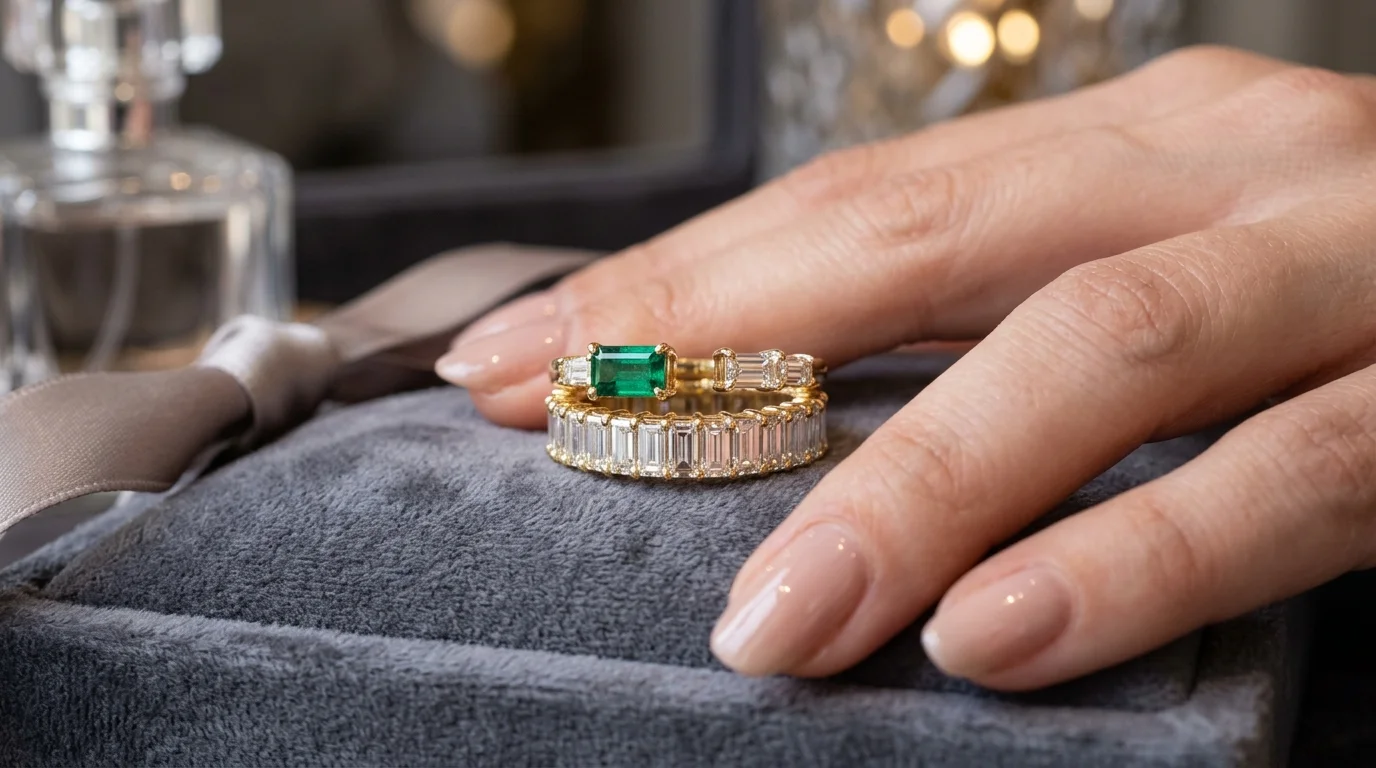
An emerald baguette open ring or a blue sapphire baguette eternity band adds a geometric pop of color that feels contemporary. When buying colored baguettes, color saturation and evenness are paramount, followed by clarity.
How to Authenticate a Baguette Diamond
Authenticating a baguette diamond requires a keen eye. Because they lack complex faceting, identifying a natural or lab-grown diamond versus a simulant like cubic zirconia or moissanite is straightforward.
A CZ baguette will look too perfect and cloud over with wear. Moissanite displays distinct double refraction and rainbow sparkle that a true diamond baguette should never exhibit. A real diamond baguette displays crisp white flashes and a deep mirror-like luster.
How to Clean and Care for Your Baguette Ring
Because baguettes rely on pristine clarity and flat facets, they show dirt, body oil, and lotions much faster than brilliant cuts. A dirty baguette will quickly look dull.
The Ideal Cleaning Routine: Soak the ring in warm water and mild dish soap for 15-20 minutes. Gently scrub around the setting and underside of stones with a soft toothbrush. Rinse thoroughly under warm water and pat dry with a microfiber cloth. Avoid harsh ultrasonic cleaners if your ring has heavily included diamonds or delicate gemstone settings.
Pros of Baguette Rings
- Sleek, architectural hall of mirrors optical effect.
- More affordable per carat than round brilliant diamonds.
- Exceptional versatility in ring stacking and band pairing.
- Appears visually larger due to shallow carat distribution.
| Step Cut Shape | Facet Layout | Length-to-Width Ratio | Minimum Clarity Needed | Best Ring Setting |
|---|---|---|---|---|
| Straight Baguette | 14 step facets, parallel sides | 2.5:1 to 3:1 (Elongated) | VS1 or higher (No inclusions) | Channel or bar set eternity band |
| Tapered Baguette | Narrowing trapezoidal ends | 1.8:1 to 2.2:1 | VS1 (Step cut exposes flaws) | Flanking side stones for solitaires |
| Emerald Cut | Rectangular with cut corners | 1.3:1 to 1.5:1 | VS2 (Center stone) | East-West or 4-prong solitaire |
| Carré Cut | Square step cut (Equal sides) | 1.0:1 (Perfect square) | VVS2 / VS1 | Art Deco geometric stacks |
Cons of Baguette Rings
- Sharp 90-degree corners can chip if not set securely.
- Requires VS2 clarity or higher as 14 facets hide no inclusions.
- Less fiery sparkle compared to round or princess cuts.
- Full eternity baguette bands cannot be resized.
Frequently Asked Questions
Are baguette diamonds cheaper than round diamonds?
Yes, baguette diamonds are generally 20% to 40% cheaper per carat than round brilliant diamonds. Cutting rectangular step cuts produces far less rough diamond waste during manufacturing and requires fewer intricate faceting operations than a 58-facet round brilliant stone.
Do baguette diamonds actually sparkle?
Baguette diamonds do not sparkle in the traditional fiery sense of round brilliant cuts. Instead of rapid fire and multi-colored light refraction, baguettes feature 14 step-cut facets that produce broad, elegant, mirror-like flashes of white light. Jewelry experts describe this optical characteristic as a hall of mirrors effect.
Can a baguette diamond chip easily?
Yes, baguette cut diamonds are more vulnerable to chipping than rounded stones because of their sharp 90-degree corners and thin perimeter edges. To prevent damage, buyers should always choose protective setting styles such as full bezel, semi-bezel, or recessed channel settings. Avoid open four-prong settings for daily-wear baguette rings.
Can you resize a baguette eternity band?
Full baguette eternity bands cannot be resized because diamonds surround the entire band. Resizing would alter the structural curve and dislodge the prongs or channel walls. However, half-eternity baguette bands feature a solid metal sizing bar at the bottom and can easily be resized by 1 to 2 sizes.
Why do my baguette diamonds look cloudy?
Baguette diamonds look cloudy when soap, lotion, or body oil accumulates on their broad top facet or beneath the setting. Because step cuts have fewer facets to scatter light, surface residue quickly dulls their mirror finish. Cleaning your ring in warm soapy water restores its clarity immediately.
What is a tapered baguette used for?
Tapered baguettes feature one end wider than the other, creating a subtle wedge shape. They are primarily used as accent side stones flanking a center gemstone in engagement rings. The taper acts as a visual guide, drawing focus inward to emphasize the center diamond's size and brilliance.
Do baguette diamonds hold their value?
Baguette diamonds retain intrinsic material value based on their carat weight, clarity, and color grade. While resale prices reflect wholesale market rates, high-grade VS baguette accent stones remain consistently in high demand among fine jewelers for custom settings, repairs, and vintage restorations.
Are lab-grown baguette diamonds a good option?
Lab-grown baguette diamonds are an exceptional option. They are physically, chemically, and optically identical to natural mined diamonds but cost up to 80% less. Since step cuts strictly require high clarity grades like VS2 or VVS, buying lab-grown lets you secure flawless clarity at a lower price point.
How do you clean baguette ring settings at home?
Clean baguette rings by soaking them in warm water mixed with a few drops of mild dish soap for 15 minutes. Softly brush under the stones with a soft toothbrush to remove debris, rinse under warm running water, and dry with a lint-free microfiber cloth.
Which setting is best for a baguette engagement ring?
Channel and bezel settings are the best options for baguette rings. Channel settings enclose baguettes between smooth metal walls to protect delicate square corners, while bezel settings wrap precious metal around every edge, shielding the stone against accidental daily knocks.
Conclusion: The Enduring Appeal of the Step Cut
Baguette diamond and gemstone rings represent the absolute epitome of sophisticated, understated luxury. They are not for those who want the loudest, flashiest ring in the room; they are for those who appreciate architectural lines, clean geometry, and impeccable craftsmanship.
Whether searching for a unique modern wedding band, a sleek engagement ring accent, or a striking standalone fashion piece, baguettes deliver a timeless aesthetic that refuses to age. By prioritizing high clarity grades, perfectly matched colors, and secure settings to protect delicate corners, you ensure your step-cut masterpiece remains a luminous part of your collection for a lifetime.
The Bottom Line: Step-cut baguette diamonds offer sleek Art Deco hall-of-mirrors geometry, but their broad, open table facets reveal internal inclusions and require higher clarity grades than brilliant cuts.
Outstanding for tailored side stones, geometric channel bands, and architectural vintage eternity rings.
Mandate VS1 or higher clarity; brilliant cuts disguise SI-grade flaws through scintillation, whereas baguettes act as transparent glass windows.
Baguette corner points are acute and vulnerable; always protect the tapered extremities with secure end-caps or protective bezel channels.
The Bottom Line: Step-cut baguette diamonds offer sleek Art Deco hall-of-mirrors geometry, but their broad, open table facets reveal internal inclusions and require higher clarity grades than brilliant cuts.
Outstanding for tailored side stones, geometric channel bands, and architectural vintage eternity rings.
Mandate VS1 or higher clarity; brilliant cuts disguise SI-grade flaws through scintillation, whereas baguettes act as transparent glass windows.
Baguette corner points are acute and vulnerable; always protect the tapered extremities with secure end-caps or protective bezel channels.
The Bottom Line: Step-cut baguette diamonds offer sleek Art Deco hall-of-mirrors geometry, but their broad, open table facets reveal internal inclusions and require higher clarity grades than brilliant cuts.
Outstanding for tailored side stones, geometric channel bands, and architectural vintage eternity rings.
Mandate VS1 or higher clarity; brilliant cuts disguise SI-grade flaws through scintillation, whereas baguettes act as transparent glass windows.
Baguette corner points are acute and vulnerable; always protect the tapered extremities with secure end-caps or protective bezel channels.
Sources & Methodology
Researched and reviewed by Bishnu Tudu (Independent Jewelry & Gemstone Researcher) in accordance with our Editorial Policy. Technical specifications, mineral durability metrics, alloy standards, and regulatory requirements were cross-referenced against the following primary sources:
- Gemological Institute of America (GIA): Diamond & Gemstone Education & Grading Standards. View GIA Standards
- Federal Trade Commission (FTC): Guides for the Jewelry, Precious Metals, and Pewter Industries. View FTC Guides
- Responsible Jewellery Council (RJC): Code of Practices for Sustainable & Ethical Jewelry Supply Chains. View RJC Standards
- Oshinic Jewels: Independent Jewelry Research, Sourcing & Editorial Methodology. View Editorial Policy