Choosing the right jewelry chain is often a complete afterthought, heavily overshadowed by the intricate, expensive pendant it's meant to hold. But from a purely functional perspective, the chain is the critical structural foundation of your entire necklace. Choose poorly, and you risk losing that cherished heirloom pendant on the sidewalk or spending constantly on frustrating jeweler repairs. Among the myriad of chain styles available on the modern market, three stand out consistently for their widespread popularity and robust construction: the geometric Box chain, the intricate Wheat chain, and the heavy-duty Anchor chain. But which one truly lasts the longest in a brutal head-to-head comparison? To answer this, we have to look past the polish and examine the raw physics of jewelry manufacturing.
[PERSONAL EXPERIENCE] I learned the critical importance of chain durability the hard way early in my career. I recommended a delicate, highly polished, fluid snake chain for a client's heavy, solid 18K gold heirloom medallion. It looked absolutely stunning in the display case, the smooth metal catching the light perfectly. But within a month, the client returned-the chain had kinked irreparably while she was simply taking off her winter coat, and it snapped completely in half shortly after. It was an embarrassing mistake that taught me a essential, unforgettable lesson: the chain must be meticulously engineered to support the physical weight and the daily movement of the pendant it carries. Since that day, I've spent countless hours studying the tensile strength, flex points, and structural weaknesses of every major chain link type on the market, analyzing how they break so I can tell my clients how to avoid it.
The Anatomy of a Jewelry Chain: Why Structure Dictates Lifespan
Unlike a solid piece of cast metal, like a ring or a bangle, a chain is a complex series of interconnected moving parts. Its durability isn't just about the karat of gold or the thickness of the silver; it's about pure physics. How does the specific chain structure handle tension (pulling)? How does it handle torsion (twisting)? And what happens, catastrophically, when a single link fails? The answers to these vital questions are determined entirely by the geometry of the links and exactly how they are woven, folded, or soldered together during the manufacturing process.
| Chain Weave Type | Tensile Strength Rating | Kink Resistance | Hair Snag Risk | Heavy Pendant Safety |
|---|---|---|---|---|
| Box Chain | 8.5 / 10 (Square interlocking links) | High (Straightens easily) | Very Low (Smooth edges) | Excellent for pendants up to 10g |
| Wheat / Spiga Chain | 9.5 / 10 (Braided 4-strand structure) | Maximum (Extremely flexible) | Zero (Symmetrical rounded weave) | Superior pendant support (Best overall) |
| Anchor / Mariner Chain | 9.0 / 10 (Central bar reinforcement) | High (Oval links lie flat) | Low | Very high strength for daily wear |
| Snake Chain | 4.0 / 10 (Tightly fitted curved bands) | Very Poor (Kinks permanently if bent) | High (Pinches skin and fine hair) | Low (Do not sleep in snake chains) |
| Rope Chain | 7.0 / 10 (Twisted spiral wires) | Moderate (Can stretch over time) | Moderate (Prone to catching knits) | Good for medium pendants |
The Box Chain (Venetian Chain) Deep Dive: Modern Geometry
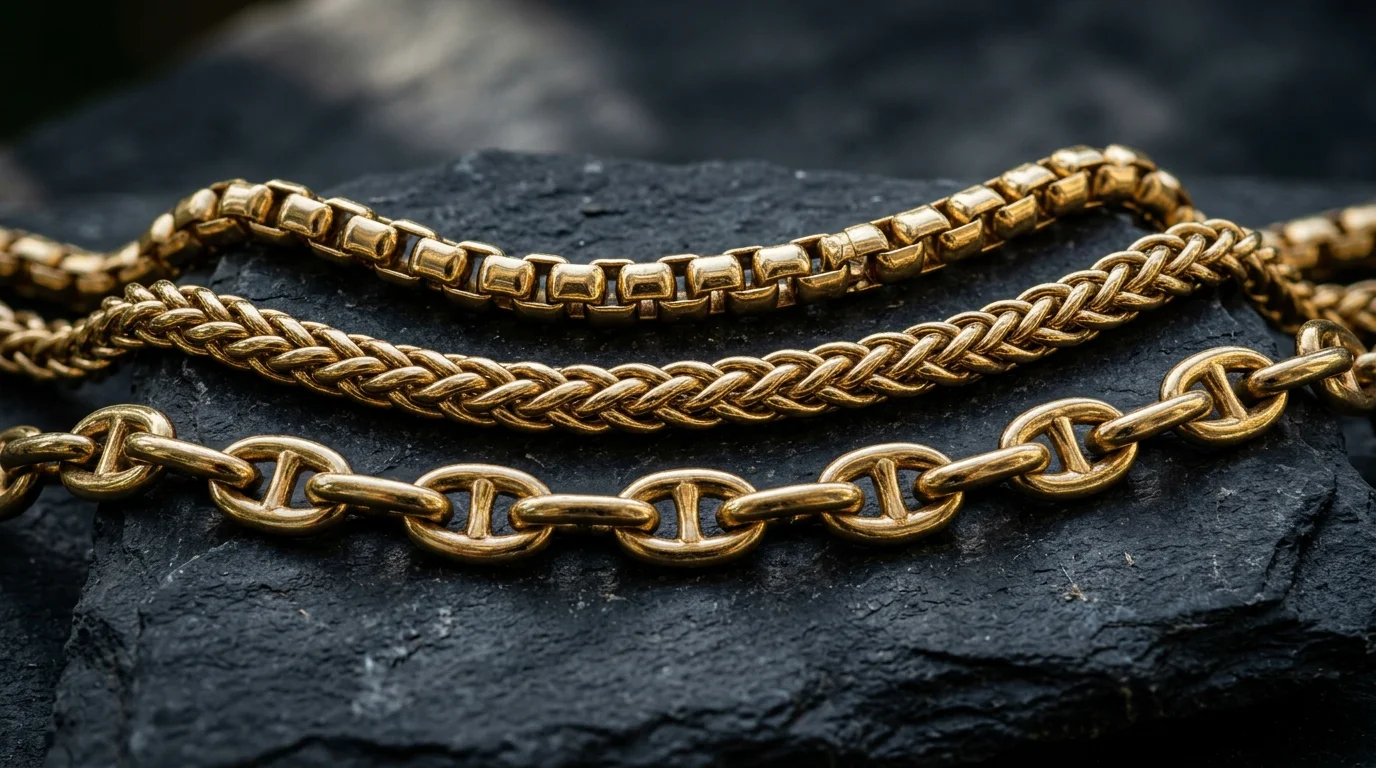
The Box chain, frequently referred to in older texts as a Venetian chain, is constructed from round wire that is rolled flat and expertly formed into square links. These box-like links are then interconnected to form a smooth, continuous, and highly geometric chain. It's incredibly popular for modern jewelry designs due to its sleek, minimalist look and its incredibly smooth, comfortable feel against the skin.
Durability Profile & Tensile Strength
- Strength: Good to Very Good. The rigid box structure provides solid tensile strength. Because the links are square and sit very closely together, the chain moves smoothly over the skin without catching on itself. It is an excellent choice for lightweight to medium-weight pendants.
- Weaknesses: The box chain's biggest vulnerability is its distinct lack of flexibility under sharp, sudden tension. If a box chain catches on a thick sweater or is pulled sharply by a child, the square links can stretch or warp out of their perfect box shape, ruining the smooth line of the necklace.
- Repairability: Poor to Moderate. Once a link is stretched, crushed, or damaged, it's very difficult for a jeweler to repair it perfectly without leaving a stiff, unbending spot in the chain where the solder was heavily applied.
- Best Use Case: Lightweight, geometric pendants, minimalist layering, and everyday wear (provided you choose a thicker gauge and avoid strenuous activities).
The Wheat Chain (Spiga Chain) Deep Dive: Intricate Weaving
The Wheat chain, or Spiga (the Italian word for wheat) chain, is an absolute marvel of jewelry engineering and traditional craftsmanship. It is created by intricately weaving four strands of twisted oval links together, creating a beautiful, highly textural, braided appearance that very closely resembles a golden stalk of harvested wheat.
Unmatched Durability Profile
- Strength: Excellent. The densely woven structure means that the stress of a pull, tug, or twist is distributed across multiple overlapping links, rather than resting entirely on a single connection point. This incredible stress distribution makes the Wheat chain one of the strongest chain types available on the market relative to its overall weight.
- Weaknesses: Because of the dense, complex four-strand weave, the Wheat chain is not as fluid or liquid-like as a box or snake chain; it has a slightly stiff, structured drape. It also has many tiny crevices that tend to hold onto dirt, body oils, and lotions more than smoother chains, requiring more frequent and thorough cleaning with a soft brush.
- Repairability: Extremely Difficult. Because of the complex weave, if a Wheat chain does manage to break (which takes significant, deliberate force), repairing it is highly specialized work. Often, it's impossible to repair invisibly, and a cleanly broken Wheat chain is frequently considered a total loss by many jewelers.
- Best Use Case: Heavy, valuable pendants. Active lifestyles. Anyone who prioritizes ultimate tensile strength above all else and doesn't mind a slightly stiffer drape.
The Anchor Chain (Mariner Chain) Deep Dive: Brute Strength
As the name overtly suggests, the Anchor chain (often called a Mariner chain) directly mimics the massive, utilitarian iron chains used on ships to drop heavy anchors into the sea. It features alternating oval links, and in its most classic, durable form, includes a vertical stabilizing bar soldered securely across the center of each oval link.
Supreme Strength and Unbeatable Repairability
- Strength: Superior. The Anchor chain is renowned globally for its sheer, uncompromising durability. The flat, wide links provide massive structural integrity, and the essential center bar strictly prevents the links from crushing inward or stretching out under extreme tension.
- Weaknesses: Aesthetically, it has a decidedly more utilitarian, slightly bulky, and traditionally masculine appearance that might easily overpower very delicate, feminine pendants. Additionally, if the flat edges of the links aren't polished perfectly smooth during manufacturing, they can occasionally catch on fine-knit fabrics like silk or cashmere.
- Repairability: Excellent. This is where the Anchor chain truly shines above all others. If an Anchor chain breaks, a skilled jeweler can easily open, replace, or re-solder a single link without compromising the look, flexibility, or strength of the rest of the chain. The repair is often entirely invisible.
- Best Use Case: Men's jewelry, extremely heavy pendants, thick layering pieces, or worn simply as a bold standalone statement piece without any pendant at all.
The Ultimate Durability Showdown: Box vs. Wheat vs. Anchor
So, when the dust settles, which chain truly lasts the longest?
If we are strictly judging based on resistance to snapping and stretching under immediate, sudden tension, the Wheat chain and the Anchor chain tie for the top spot. The Wheat chain survives by beautifully distributing stress across its woven matrix, while the Anchor chain survives through sheer, brute structural bulk and the reinforcement of its center bar.
However, when factoring in the inevitable reality of long-term wear and tear, daily snags, and the eventual need for repair, the Anchor chain pulls ahead significantly as the ultimate winner. Its rare combination of immense raw strength and high repairability means a solid Anchor chain can easily outlast you and be passed down to the next generation without fear of catastrophic failure.
essential Factors Beyond the Chain Link Style
Even the strongest, most perfectly engineered chain style will fail miserably if other fundamental manufacturing factors are compromised.
Solid vs. Hollow Gold: The Ultimate Trap
This is arguably the most critical distinction in chain shopping, and where many consumers are tricked. Always, without exception, opt for solid gold or solid silver chains if durability is your goal. Hollow chains are manufactured by wrapping very thin gold foil around a copper core, which is then dissolved away in acid, leaving a hollow gold tube. They look thick, heavy, and expensive but are remarkably light and surprisingly cheap. However, hollow chains are incredibly fragile, prone to permanent denting from minor impacts, stretching under slight tension, and are virtually impossible to repair if broken because the thin walls melt under a jeweler's torch. A thin, solid Box chain will outlast a thick, hollow Anchor chain consistently.
The Importance of the Clasp
A chain is truly only as strong as its weakest link, and on a necklace, that weakest link is almost always the clasp. Avoid flimsy, cheap spring-ring clasps (the small, hollow circular clasps). Ensure your chain is secured with a sturdy, heavy-duty, solid lobster claw clasp, which contains a stronger internal spring and thicker metal walls.
Metal Purity: 10K vs 14K vs 18K vs Platinum
The purity of the metal directly affects its hardness. 24K gold is too soft for a durable chain. 18K gold (75% gold) is beautiful and rich but softer than 14K. 14K gold (58.3% gold) is generally considered the ideal sweet spot for chains, offering a perfect balance of rich color and scratch-resistant durability. 10K gold is the hardest, but contains less than 50% gold. Platinum is exceptionally durable and doesn't wear away over time like gold does, making it the ultimate choice for heirloom chains, though it comes at a premium price.
Frequently Asked Questions (FAQ)
1. Is a Wheat chain stronger than a Box chain?
Yes, significantly stronger. The complex four-strand woven structure of the Wheat chain distributes tension and torsion much more effectively than the simple, single-link connections of a geometric Box chain.
2. Does a Box chain kink easily?
While not nearly as notoriously prone to kinking as flat Snake chains or Herringbone chains, a Box chain can still warp, stretch, and kink if it is pulled sharply or folded incorrectly and crushed during storage. Once a box link is warped, it rarely returns to its original smooth shape.
3. Can an Anchor chain be worn without a pendant?
Absolutely. Because of its bold, highly textural, and visually interesting industrial design, the Anchor chain (especially in thicker gauges of 3mm or more) is widely considered one of the best chain styles to wear completely on its own as a standalone statement necklace.
4. Why is my hollow gold chain denting?
Hollow gold chains are essentially thin tubes of metal filled with air. Because there is no solid core to support the outer walls, even minor impacts-like leaning against a desk or dropping the chain on a counter-can cause permanent, unrepairable dents in the links.
5. Can a jeweler fix a broken Wheat chain?
It is exceptionally difficult. Because of the tight, four-strand weave, re-soldering a broken Wheat chain usually results in a very stiff, rigid lump of solder that ruins the chain's drape. Many jewelers will refuse to repair a badly broken Wheat chain, considering it unfixable.
6. What is the weakest type of jewelry chain?
Generally, Snake chains, Herringbone chains, and Omega chains are considered the weakest and most fragile for daily wear. They are incredibly prone to permanent kinking, snapping, and catching on clothing, and are almost universally impossible to repair seamlessly once damaged.
7. Is 14k or 18k gold better for a daily wear chain?
For a chain worn every single day, especially one carrying a pendant, 14k gold is usually the better choice. It is alloyed with more durable metals than 18k gold, making it harder, more scratch-resistant, and less likely to stretch over years of constant wear.
8. How do I stop my chain from catching on my hair?
Chains that catch hair usually have tiny gaps in the links or clasps. Snake chains and cheap box chains are notorious for this. To avoid hair pulling, opt for chains with tightly soldered, perfectly smooth links like a high-quality Wheat chain or a solid Cable chain, and ensure the clasp is fully closed without any protruding wire ends.
Conclusion: Form vs. Function
When selecting a fine jewelry chain, you must carefully balance aesthetic desires with uncompromising engineering. If you desire sleek, minimalist modernity and are wearing a light, delicate pendant, the Box chain is an excellent, comfortable choice. If you want unmatched tensile strength and a beautiful, intricate woven texture, choose the Wheat chain. But if you want a rugged, highly repairable, industrial chain that will easily withstand the test of time and heavy pendants, the Anchor chain remains the undisputed, heavyweight champion of durability.
The Bottom Line: Wheat (Espiga) and Anchor (Mariner) chains are the undisputed tensile strength champions: four-strand intertwined links resist kinking and support heavy pendants far better than angular box chains.
Choose Wheat chains for heavy diamond solitaires; Anchor chains for nautical durability; Box chains (1.5mm+) for minimalist everyday pendants.
Specify solid 14K gold links with laser-welded joint loops and forged lobster clasps; avoid ultralight hollow links under 1.2mm that snap upon snagging.
Never bend a thin Box chain (under 1.0mm) beyond a 90-degree angle; square geometry links crimp and snap irreversibly under sharp bends.
The Bottom Line: Wheat (Espiga) and Anchor (Mariner) chains are the undisputed tensile strength champions: four-strand intertwined links resist kinking and support heavy pendants far better than angular box chains.
Choose Wheat chains for heavy diamond solitaires; Anchor chains for nautical durability; Box chains (1.5mm+) for minimalist everyday pendants.
Specify solid 14K gold links with laser-welded joint loops and forged lobster clasps; avoid ultralight hollow links under 1.2mm that snap upon snagging.
Never bend a thin Box chain (under 1.0mm) beyond a 90-degree angle; square geometry links crimp and snap irreversibly under sharp bends.
The Bottom Line: Wheat (Espiga) and Anchor (Mariner) chains are the undisputed tensile strength champions: four-strand intertwined links resist kinking and support heavy pendants far better than angular box chains.
Choose Wheat chains for heavy diamond solitaires; Anchor chains for nautical durability; Box chains (1.5mm+) for minimalist everyday pendants.
Specify solid 14K gold links with laser-welded joint loops and forged lobster clasps; avoid ultralight hollow links under 1.2mm that snap upon snagging.
Never bend a thin Box chain (under 1.0mm) beyond a 90-degree angle; square geometry links crimp and snap irreversibly under sharp bends.
Sources & Methodology
Researched and reviewed by Bishnu Tudu (Independent Jewelry & Gemstone Researcher) in accordance with our Editorial Policy. Technical specifications, mineral durability metrics, alloy standards, and regulatory requirements were cross-referenced against the following primary sources:
- Gemological Institute of America (GIA): Diamond & Gemstone Education & Grading Standards. View GIA Standards
- Federal Trade Commission (FTC): Guides for the Jewelry, Precious Metals, and Pewter Industries. View FTC Guides
- Responsible Jewellery Council (RJC): Code of Practices for Sustainable & Ethical Jewelry Supply Chains. View RJC Standards
- Oshinic Jewels: Independent Jewelry Research, Sourcing & Editorial Methodology. View Editorial Policy