The Anatomy of Earring Construction
Earrings operate under completely different physical parameters than rings or bracelets. They are not subjected to impact or heavy friction, but they face constant gravitational pull and must interact directly with biological tissue. When we evaluate earrings, we focus entirely on weight distribution, post thickness, and backing security. A heavy chandelier earring constructed from solid gold may be visually impressive, but if it causes severe lobe distension or tearing, it is structurally flawed. We advocate for strategic hollowing or lightweight alloy usage in large earring designs to preserve tissue integrity.
Ear Stacking and Placement
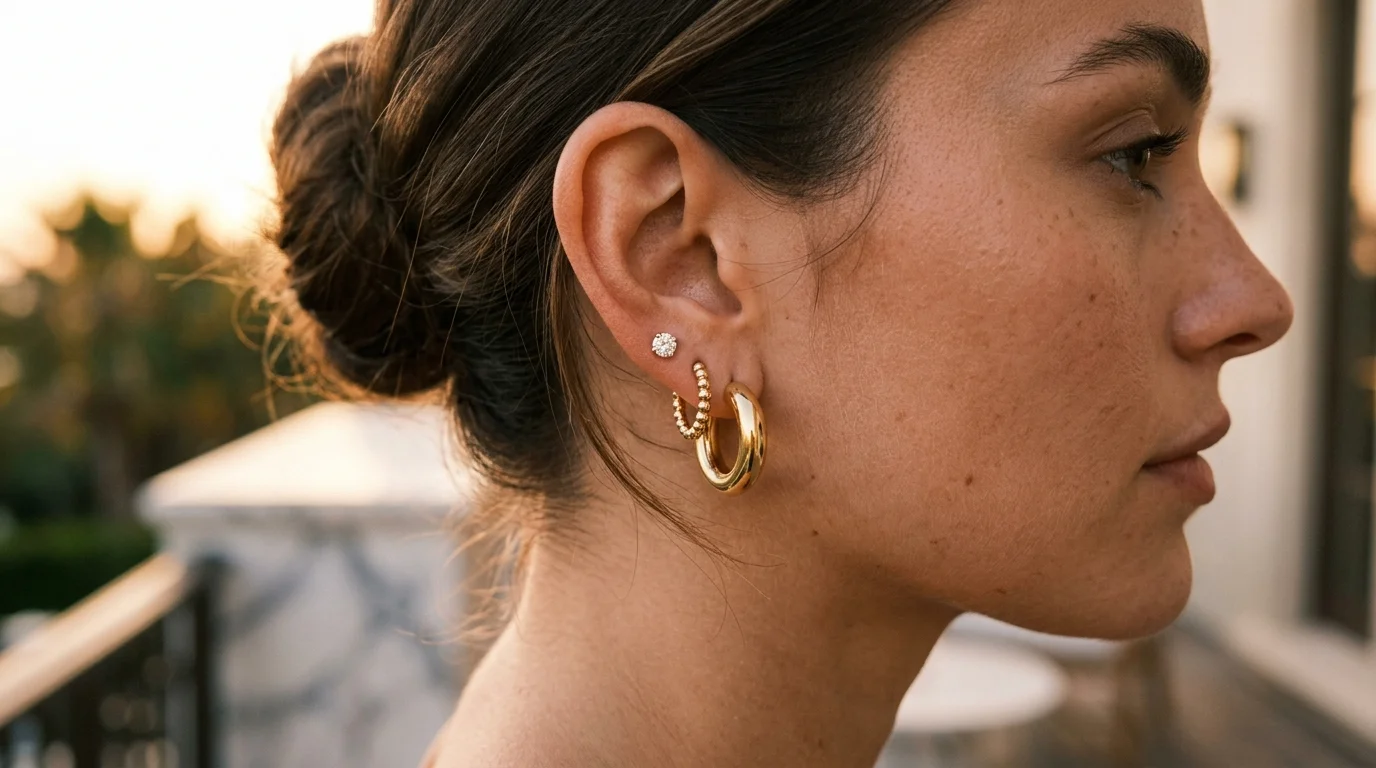
The modern approach to earrings involves complex curation, building an 'ear stack' across multiple piercings. We analyze the geometry of huggies, studs, and cartilage hoops. Cartilage piercings require specific gauge thicknesses and highly unreactive metals like implant-grade titanium or solid 14k gold, as cartilage heals poorly and is highly prone to infection. We guide buyers on mapping their ear anatomy, selecting appropriate hoop diameters, and ensuring comfortable sleep mechanics for pieces intended for continuous wear.
Backing Systems and Security
The loss rate for earrings is astronomical, almost entirely due to failed backing systems. We rigorously test the mechanics of friction backs (butterflies), screw backs, and La Pousette (locking) backs. Friction backs degrade over time, losing tension and slipping off the post. While screw backs offer perceived security, the threaded post can trap bacteria and damage the piercing fistula if forced. For high-value diamond studs, we mandate dual-action locking backs, which require mechanical triggers to release, ensuring the piece cannot be accidentally pulled through hair or clothing.
Biocompatibility and Metals
Because earring posts sit internally within a puncture wound, biocompatibility is paramount. We heavily scrutinize the alloys used in posts. Nickel is strictly forbidden in our recommendations due to its high allergenicity. We educate buyers on the difference between 'hypoallergenic'—an unregulated marketing term—and true biocompatibility found in high-karat gold, platinum, and surgical titanium. Understanding the metallic composition of the post, regardless of the earring's decorative face, is the only way to prevent chronic contact dermatitis.