Introduction
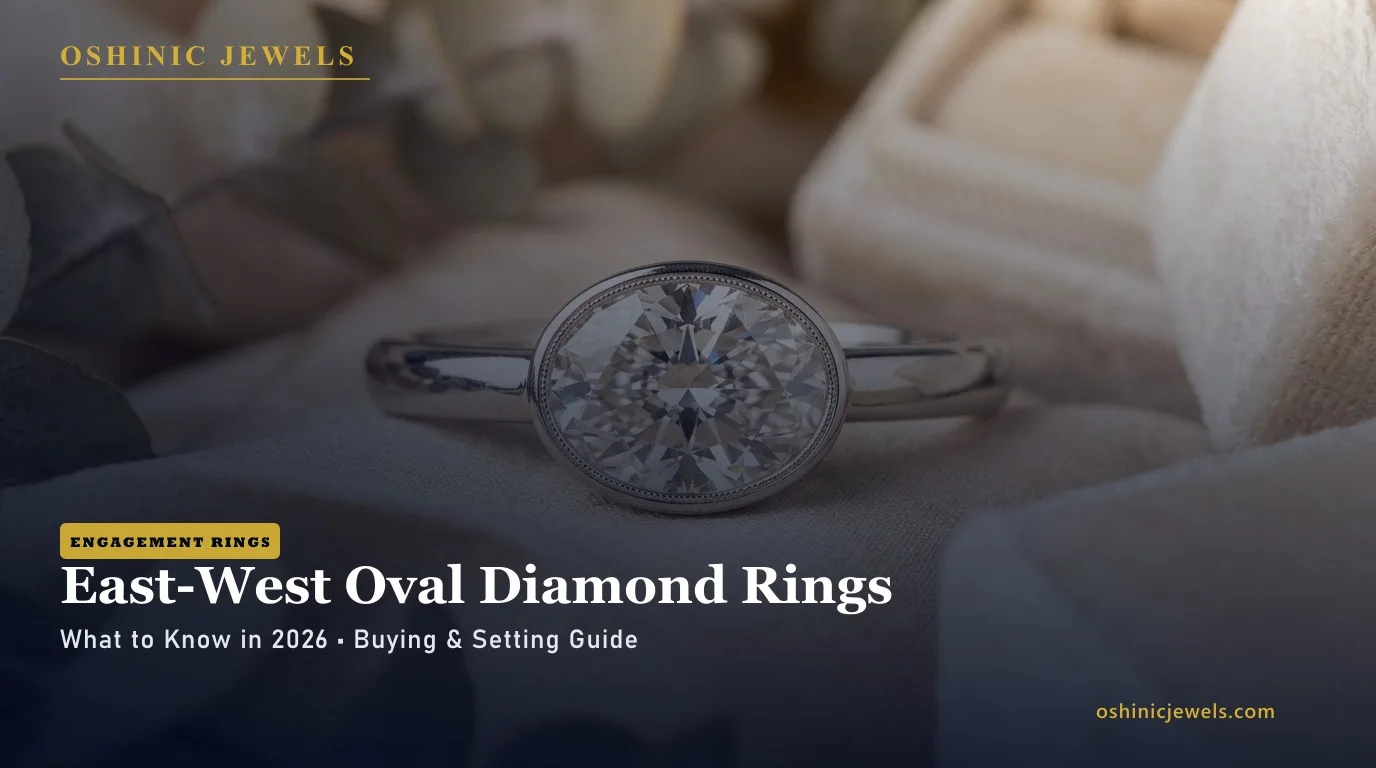
East-West oval diamond engagement rings turn the familiar oval silhouette sideways, creating a design that feels contemporary without abandoning classic diamond elegance. The horizontal orientation emphasizes width across the finger rather than length along it, which can make even a simple solitaire appear intentional and distinctive. This style has gained visibility as buyers seek lower-profile, personalized alternatives to conventional engagement rings. Yet its long history in jewelry design means it is more than a novelty created for a single trend cycle.
Choosing one requires more than finding an oval diamond and rotating it 90 degrees. The diamond’s length-to-width ratio, bow-tie effect, setting height, wedding-band clearance, and prong placement all influence the final appearance and durability. A well-designed East-West ring looks balanced from every angle and protects the stone at its vulnerable ends. This guide explains what buyers should examine before selecting an East-West oval ring in 2026.
- Compare oval diamonds by millimeter dimensions and visual performance, not carat weight alone.
- View the diamond horizontally in several lighting conditions to assess its bow-tie effect.
- Choose a full bezel for greater edge coverage or prongs for a lighter, more open appearance.
- Confirm wedding-band clearance before approving the engagement-ring design.
- Use actual-scale previews to check finger coverage and adjacent-finger comfort.
- Request written details covering origin, grading, metal, warranties, returns, and customization.
- Remove the ring during high-impact activities and arrange professional inspections when needed.
What Is an East-West Oval Diamond Engagement Ring?
An East-West oval engagement ring holds an oval diamond with its long axis running across the finger. A traditional north-south ring places the oval vertically, with its pointed ends facing toward the fingertip and wrist. Turning the diamond horizontally changes its visual relationship with the hand, even though the stone’s carat weight and physical measurements remain the same. Jewelers may also describe the style as a horizontal oval, sideways oval, or transverse oval setting.
The design can appear in solitaires, three-stone rings, bezels, halos, tension-inspired mountings, and wider sculptural bands. A minimal four-prong solitaire offers the lightest visual treatment, while a full bezel creates a clean outline and additional edge protection. Half-bezels leave portions of the stone exposed and can produce a more open appearance. Decorative settings may add side stones, milgrain, engraving, or contrasting metal around the center diamond.
Orientation affects perceived shape but does not change the diamond’s objective quality. An oval with a pronounced bow tie, uneven outline, or poor symmetry will not improve simply because it is mounted horizontally. In fact, the sideways position may draw greater attention to width, outline consistency, and dark areas across the diamond’s center. Buyers should therefore evaluate the loose stone face-up before approving the finished mounting.
East-West designs often spread visually across more of the finger than traditional vertical ovals. This can create substantial side-to-side presence, especially when the diamond has a broad shape or the setting includes a bezel. However, horizontal placement may make the stone appear shorter or less elongated at first glance. Shoppers who associate apparent size with vertical length should compare both orientations on their own hand before deciding.
The style also changes how a ring interacts with nearby jewelry. Low baskets, wide bezels, and horizontally projecting stones can prevent a straight wedding band from sitting flush. A raised gallery may solve that problem, although greater height can increase snagging and expose the ring to impacts. The best design balances appearance, comfort, protection, and future band pairing rather than optimizing only one feature.
Why East-West Oval Rings Stand Out in 2026
The strongest appeal of an East-West oval ring is its balance between recognizable and unconventional design. Oval diamonds remain familiar, flattering, and widely available, but changing their orientation gives them a fresh architectural quality. Buyers can express individuality without choosing an extremely unusual gemstone shape or an elaborate mounting. That makes the style accessible to minimalists, fashion-focused shoppers, and collectors of distinctive fine jewelry.
Current bridal preferences increasingly favor personalization over strict adherence to one traditional silhouette. East-West rings fit that preference because small design decisions can substantially alter the result. A slim yellow-gold bezel feels warm and understated, while white-metal claw prongs create a crisp diamond-forward appearance. A heavier platinum band can look sculptural, whereas rose gold introduces softer contrast.
Practical considerations also support the style’s popularity. Horizontal placement can allow a lower setting because the stone may nestle closer to the finger, depending on the basket and band construction. A low-profile ring can feel comfortable for people who wear gloves, work with their hands, or dislike tall center stones. Nevertheless, low profile does not automatically mean secure, and the mounting still needs adequate metal around attachment points.
East-West oval diamond engagement rings are especially appealing to shoppers who want broad finger coverage. Carat weight measures mass, not visible size, so two diamonds of equal weight can have different face-up dimensions. A well-cut oval with favorable measurements may provide a larger visible footprint than a deep stone carrying hidden weight below the girdle. Horizontal orientation then emphasizes that footprint across the hand.
The design has weaknesses that buyers should recognize. Its proportions can look cramped on a very narrow band if the stone overhangs excessively, and wide settings may rub against neighboring fingers. Some wedding bands require a contour, gap, or open design to fit around the center setting. Resizing can also be complicated when the shank includes continuous pavé, engraving, or an integrated bezel.
The 2026 interest in East-West settings should not be confused with a guarantee of future resale value. Style popularity rarely determines what a pre-owned engagement ring will recover, because diamond characteristics, craftsmanship, condition, documentation, and market demand matter more. Buyers should choose the orientation because they genuinely enjoy it. Those researching broader oval diamond styles or modern solitaire settings can compare those categories before committing.
Choosing the Best Oval Diamond
Oval diamonds do not receive a standardized overall cut grade from the Gemological Institute of America in the same way that round brilliant diamonds do. Buyers must therefore assess appearance using measurements, symmetry, polish, video, images, and direct observation. A grading report remains important for documenting characteristics such as carat weight, color, clarity, fluorescence, and dimensions. It should support visual evaluation rather than replace it.
Length-to-width ratio describes how elongated an oval appears and is calculated by dividing length by width. Many conventional oval diamonds fall around 1.30 to 1.50, but there is no universally correct ratio for an East-West ring. Broader stones near the lower end can feel substantial and pillowy, while more elongated stones create a stronger horizontal line. Extremely long shapes may project toward adjacent fingers or require a wider setting.
Face-up dimensions deserve close attention because carat weight alone can be misleading. A deep oval may retain weight beneath the girdle and look smaller than another diamond of the same carat weight. Compare the millimeter length and width of several candidates, then consider whether their brilliance and durability remain satisfactory. Avoid selecting a shallow stone solely for spread, since excessive shallowness may reduce light performance.
The bow-tie effect is a dark or shadowed band that can appear across the center of many elongated brilliant-cut diamonds. Some bow tie is common in ovals and does not automatically make a stone unattractive. Problems arise when the dark area remains dominant across different lighting conditions or interrupts the sparkle pattern. Videos should show the diamond moving through diffused daylight, spotlighting, and ordinary indoor light whenever possible.
A horizontal mounting can make the bow tie feel more noticeable because the dark band may run vertically once the stone is rotated. That orientation can visually divide the diamond into left and right sections. Examine the stone in its intended position rather than relying only on standard vertical product images. Ask for a temporary holder, rendered preview, or accurate face-up photograph if an in-person comparison is unavailable.
Color and clarity should be selected according to the setting and the viewer’s priorities. Yellow or rose gold may make slight warmth less noticeable from the side, although a white bezel or white prongs can highlight color differences. Eye-clean clarity is generally more valuable to appearance than paying for microscopic purity that cannot be seen without magnification. Always inspect the location and nature of inclusions, particularly near the girdle or the oval’s ends.
Natural and lab-grown diamonds can both work in East-West mountings. They share essentially the same physical and optical properties when they are diamonds, but their origin, pricing, availability, and likely resale behavior differ. Federal Trade Commission guidance requires sellers to describe laboratory-grown origin clearly and avoid misleading representation. Buyers comparing natural and lab-grown diamond topics should focus on disclosure, grading documentation, budget, and personal preference.
East-West Setting Styles Compared
The setting determines how secure, comfortable, and visually prominent an East-West oval diamond will be. It also controls cleaning access, wedding-band fit, and the amount of metal visible around the center. No single style is best for every wearer. Lifestyle and craftsmanship matter as much as appearance.
| Setting style | Main advantage | Main drawback | Best suited for |
|---|---|---|---|
| Four-prong solitaire | Minimal metal and strong diamond visibility | Exposed girdle and ends | Careful wearers seeking a classic look |
| Six-prong setting | Additional contact points | More visible metal | Buyers prioritizing prong coverage |
| Full bezel | Strong edge protection and clean outline | May appear heavier or reduce side light | Active lifestyles and modern designs |
| Half-bezel | Open appearance with partial protection | Exposed sections require thoughtful engineering | Contemporary, architectural rings |
| Halo | Greater visual presence | More maintenance and a busier appearance | Buyers who enjoy sparkle and detail |
| Three-stone | Symbolic design and wide coverage | Can feel broad between adjacent fingers | Larger hands or statement-ring preferences |
A four-prong East-West solitaire usually places prongs near the oval’s four diagonal corners. This preserves visibility but may leave the ends exposed unless the prongs or basket are carefully positioned. End prongs can protect the tips more directly, though their placement changes the ring’s visual symmetry. Prongs should sit securely against the diamond without gaps, roughness, or excessive bulk.
A six-prong design distributes contact across more points and can provide reassurance if one prong becomes damaged. More prongs do not automatically make a poorly constructed ring safe, however. Metal thickness, alloy, seat cutting, finishing, and maintenance all affect security. Fine claw prongs may look delicate but still need enough material to withstand normal wear.
A full bezel surrounds the diamond’s girdle with a rim of metal. It offers strong protection against direct edge impacts and produces a distinct horizontal outline. Bezel construction must be precise because uneven metal can conceal too much of the diamond or create an asymmetrical border. Some bezel-set stones also require professional cleaning attention where residue collects beneath the setting.
Half-bezels usually hold the diamond along its ends or sides while leaving other areas open. They can showcase more of the stone and create an elegant floating effect. Their safety depends heavily on engineering, so buyers should avoid judging them by appearance alone. Ask how the diamond is seated, which areas bear pressure, and whether the design has been tested for everyday wear.
Halos and three-stone designs create greater finger coverage but introduce more maintenance. Small pavé diamonds may loosen over time, particularly if the ring receives repeated impacts or is resized improperly. Side stones can also compete with the horizontal center unless their shapes and scale are carefully coordinated. Buyers should inspect symmetry and confirm that replacement melee can be sourced if future repairs become necessary.
Wedding Bands, Hand Shape, and Everyday Comfort
An East-West oval changes the visual width of the finger, so proportion matters more than rigid hand-shape rules. A long horizontal oval can create a bold line across broad fingers, while a compact oval may feel more balanced on smaller hands. Narrow fingers can still wear the style successfully if the center does not press against adjacent fingers. Personal preference should outweigh claims that one finger shape is objectively ideal.
Trying the ring at full scale is essential because enlarged online images distort proportion. Print or digitally render the stone using its actual millimeter dimensions, then place the representation across the intended finger. Account for the bezel or prongs, which can add visible width beyond the diamond. Also test how the ring feels when making a fist, typing, gripping objects, and placing fingers together.
Band width influences both appearance and stability. A very thin shank can make the center look dramatic but may rotate, bend, or feel visually disconnected from a wide stone. A somewhat more substantial band can distribute weight and provide better structural support. The appropriate width depends on metal, construction, stone size, ring size, and whether pavé weakens parts of the shank.
Wedding-band compatibility should be planned before the engagement ring is finalized. A straight band can sit flush when the gallery provides enough clearance beneath the center setting. Low baskets and full bezels often create a gap, which some wearers enjoy as part of a stacked look. Others may prefer a curved, notched, open, or custom-fitted band.
A fitted band creates a cohesive silhouette but may look incomplete when worn alone. Open bands accommodate a projecting center but require adequate structure and can catch on objects if their ends are poorly finished. A spacer band may reduce direct rubbing between diamond-set rings, although it changes the stack’s total width. Try the full intended stack instead of evaluating each ring separately.
Comfort also depends on surface finishing and side profile. Sharp basket corners, protruding prongs, and thick bezel edges can irritate neighboring fingers. A ring that feels acceptable for five minutes may become uncomfortable over a full day. Request softened edges, inspect the underside, and confirm that any open gallery does not trap skin.
Lifestyle should guide the final height and protection level. Medical professionals, athletes, caregivers, mechanics, gardeners, and frequent glove wearers may prefer a lower bezel or robust prong architecture. Even a protective setting should be removed for activities involving heavy impact, chemicals, or machinery. Jewelry is durable, but an engagement ring is not highly durable.
Price Guide and Smart Buying Checklist
The price of an East-West oval ring depends primarily on the center diamond, metal, design complexity, craftsmanship, and brand positioning. Simply rotating a standard prong basket may add little cost, while a custom bezel or hand-fabricated gallery can require substantially more labor. Natural diamonds and lab-grown diamonds operate in different price markets, so comparisons should use equivalent origin and grading characteristics. Exact prices change frequently and should be confirmed with current written quotes.
Custom work may include computer-aided design, model production, casting or fabrication, stone setting, finishing, and revisions. Ask whether the quoted price includes the center stone, accent stones, grading report, sizing, engraving, shipping, insurance, and applicable taxes. Clarify how many design revisions are included before extra fees apply. A low quote can become less attractive if essential services are excluded.
Metal selection affects both price and performance. Platinum is dense, naturally white, and often chosen for durable prong or bezel work, but it generally costs more to manufacture and has its own wear characteristics. White gold commonly requires rhodium plating to maintain a bright white surface, while yellow and rose gold avoid that particular maintenance step. Alloy composition and karat should always be disclosed.
Use a written checklist when comparing rings:
- Verify the diamond’s report number, dimensions, origin disclosure, and seller return terms.
- Review videos of the oval in several lighting environments and in horizontal orientation.
- Confirm the setting’s metal, width, height, prong count, and protection at both ends.
- Ask whether a straight wedding band will sit flush and request a side-profile drawing.
- Inspect the bow tie, outline symmetry, girdle condition, and visible inclusions.
- Obtain maintenance, warranty, resizing, and loss-coverage terms in writing.
- Arrange independent insurance or confirm whether an existing policy provides suitable coverage.
Common mistakes include shopping by carat weight alone, assuming all bezels are equally protective, and approving a design without millimeter-scale visualization. Another mistake is choosing extremely delicate metalwork to imitate enlarged product photography. Thin prongs and narrow shanks may require more frequent maintenance and can deform under ordinary stress. Durability should be discussed before aesthetic details become fixed.
Buyers should also understand the seller’s upgrade, return, and buyback policies. Such programs vary and may contain exclusions, minimum spending requirements, or time limits. Do not treat a verbal description as a contractual promise. Read the current policy and retain invoices, grading documents, appraisals, and design approvals.
For online purchases, inspect the ring promptly during the return period. Check that the center diamond matches its documentation and that the ring size, metal, engraving, and finish match the order. An independent qualified appraiser can provide another perspective on workmanship and identification. Shoppers may also benefit from reviewing general diamond care guides and engagement-ring metal comparisons before purchase.
Durability, Care, and Maintenance
Oval diamonds are suitable for daily-wear jewelry, but their elongated girdle and curved ends still need protection. A hard gemstone can resist scratching while remaining vulnerable to chipping from a sharp impact at the wrong angle. Prongs, bezels, and galleries absorb much of the abuse encountered in normal wear. Their condition should be checked regularly.
Clean the ring with lukewarm water, mild dish soap, and a soft brush unless the jeweler provides different instructions for the specific design. Brush beneath the diamond where lotion, soap, and skin oils collect, then rinse carefully and dry with a lint-free cloth. Avoid cleaning over an open drain. Harsh chemicals, abrasive powders, and household bleach can damage metal or affect finishes.
Ultrasonic and steam cleaners are not automatically suitable for every ring. Loose stones, fracture-filled diamonds, delicate pavé, certain treatments, or damaged settings may make mechanical cleaning unsafe. Ask a jeweler to inspect the ring before using such equipment. When uncertain, gentle manual cleaning is the safer starting point.
Examine prongs for lifting, flattening, snagging, or visible gaps. A bezel should have an even rim without dents or sections pulling away from the diamond. Stop wearing the ring if the stone clicks, rotates, or feels loose. Place it in a protected box and arrange professional service rather than testing it repeatedly.
Maintenance frequency depends on wear, setting style, and lifestyle. A person who wears a ring during frequent physical work may need inspections more often than someone who wears it selectively. Many jewelers recommend periodic professional checks, but the appropriate schedule should come from the jeweler responsible for the ring. Insurance inspections and warranty requirements may also dictate timing.
Remove the ring before weightlifting, contact sports, heavy cleaning, gardening, swimming, and using machinery. Chlorinated water and cleaning chemicals can affect some alloys, while cold water may make fingers shrink enough for rings to slip off. Store the ring separately so diamonds do not scratch other jewelry. A fabric-lined compartment or individual pouch reduces contact damage.
Frequently Asked Questions
Why are east-west oval engagement rings trending on Reddit?
East-west oval rings turn the diamond 90 degrees horizontally across the finger. Buyers love the modern, edgy look and enhanced horizontal finger coverage without needing a higher carat weight.
Does an east-west oval ring look good on short or wide fingers?
Yes! Horizontal settings provide wider visual width across the finger band. A bezel or low-profile East-West setting creates a flattering horizontal balance for all finger lengths.
Is an east-west oval diamond ring harder to match with a wedding band?
Standard straight wedding bands may leave a small gap next to an east-west oval head. Jewelers recommend pairing with a custom curved, chevron, or open ring guard for a flush fit.
What is the best setting type for an east-west oval diamond?
A full bezel or semi-bezel setting offers the sleekest, modern look while protecting the diamond's vulnerable oval tips from catching on clothing or daily impact.
Do east-west oval rings catch on clothing more easily?
No. Because the stone lies horizontally along the width of your finger rather than extending vertically toward the knuckle, it has a lower clearance profile that catches less.
Are east-west engagement rings a temporary trend or timeless?
While horizontal orientation spiked in 2026, east-west setting dates back to Art Deco era design. It is considered an enduring alternative setting style for unique buyers.
What bow-tie effect should I look for in an east-west oval diamond?
The bow-tie (dark shadow across the center) can be more noticeable horizontally. Select an oval with a length-to-width ratio of 1.35 to 1.45 and excellent symmetry to minimize bow-tie shadows.
Can any oval diamond be set east-west in a ring setting?
Yes! Jewelers can custom mount almost any loose oval diamond into a dedicated horizontal 4-prong, 6-prong, or bezel east-west head.
Final Verdict
East-West oval diamond engagement rings are an excellent choice for buyers who appreciate familiar materials presented in a less conventional way. Their greatest strengths are broad finger coverage, modern visual balance, flexible setting options, and compatibility with both natural and lab-grown diamonds. Bezel and low-profile versions can also provide practical advantages for people who dislike tall, snag-prone rings.
The design is less suitable for someone who strongly prefers the lengthening appearance of a traditional vertical oval or wants every straight wedding band to sit flush without advance planning. Highly elongated stones may feel wide between neighboring fingers, while low baskets can complicate stacking. A strong bow tie may also become more visually prominent after the diamond is rotated.
The best East-West ring combines an attractive loose oval with a setting engineered specifically for horizontal placement. Review the diamond in motion, compare actual measurements, inspect end protection, and test the intended wedding-band pairing. Choose the style for its lasting personal appeal rather than its trend status, and prioritize sound construction over extremely delicate proportions.
Conclusion
East-West oval diamond engagement rings offer a compelling alternative to standard solitaire orientation. They feel distinctive without becoming difficult to recognize, style, or personalize. Their horizontal profile can emphasize finger coverage, complement modern bezels, and support understated or elaborate designs. The result works especially well when every proportion is considered together.
A successful purchase begins with the diamond’s visible beauty and continues through thoughtful setting construction. Bow tie, spread, ratio, prong placement, bezel quality, ring height, and band clearance all deserve attention. Documentation and return policies provide additional protection, but they cannot substitute for careful visual inspection. Whenever possible, compare several stones and mountings at actual scale.
The East-West oval is likely to remain relevant beyond 2026 because its appeal comes from a simple, adaptable design choice. It can feel contemporary in a minimal solitaire, vintage-inspired with milgrain, or sculptural in a heavy bezel. Buyers who select balanced proportions and durable craftsmanship can enjoy a ring that feels individual without depending entirely on a passing fashion moment.
Sources & Methodology
This article was researched and written in accordance with the Oshinic Jewels Editorial Policy. Claims regarding gemstone quality, metal durability, pricing, sizing, and skin health were independently verified against the following authoritative industry standards:
- Gemological Institute of America (GIA): Diamond & Gemstone Education & Grading Standards. View GIA Standards
- Federal Trade Commission (FTC): Guides for the Jewelry, Precious Metals, and Pewter Industries. View FTC Guides
- Responsible Jewellery Council (RJC): Code of Practices for Sustainable & Ethical Jewelry Supply Chains. View RJC Standards
- Oshinic Jewels: Independent Jewelry Research, Sourcing & Editorial Methodology. View Editorial Policy